Erie, Pennsylvania
Thursday, September 3, 2015
I want to keep focused on Archie and continue my writing about him, but I am taking a couple of detours. The book my brother loaned me is titled WITH THE 112TH IN FRANCE: A DOUGHBOY'S STORY OF THE WAR by James A. Murrin, published in 1919.What a treasure this book is--my brother purchased it years ago knowing that our Uncle Roy was in the 112th and I know now the 28th Division.
Corporal Murrin kept a diary and his letters home from the very beginning when the 16th and the 8th Pennsylvania National Guard Infantry Regiments combined into the 112th. So far I have read about the training in Augusta, Georgia, the troop train to New York, the crossing aboard the Aquitania, and now the Regiment's arrival in France, all in stunning detail. Reading this book has enriched my understanding of the experience that Archie had before he went to France. Roy was Archie's nephew.
I am thrilled to be reading such a book. A little search showed that the book is still available online for about $35 hardcover, but certainly not this 1st Edition. My brother was very thoughtful to loan it to me.
I took a little break from 112th book today and discovered that there is a history of the 37th Engineers, Company E/AEF available from a collection digitized by Google. I cannot believe it. The 37th Engineers, Company E is the unit my Grand (some say Great) Uncle Earl was in and his name is listed in the book. Earl was Archie's brother in law.
The past ten days I have had the luxury of continuing my Great War quest, but I know the next few days will be about family. I hope that they will let me fill them in about our heritage!!
Thursday, September 3, 2015

Wednesday, September 2, 2015
"La Meuse exhume la Grande Guerre"
Erie, Pennsylvania
Wednesday, September 2, 2015
At the Hotel St. Paul in Verdun, France I spotted this headline, "La Meuse exhume la Grande Guerre" in L'Est Republican, Dimanche, 16 Aout 2015. Valerie told me that I could keep the newspaper.
The article focused on the discovery Thursday, August 13, of some human skeletal remains at Fleury-devant-Douaumont that are believed to be those of a German soldier from World War I. Buttons and other artifacts found at the site confirmed this.
There turned out to be three articles in the paper about the Great War. Besides the one mentioned above, another article was about a conference with a focus on the environmental heritage of the Great War.
The third article was about a three day biker tour around the Verdun area, including Argonne, the destroyed villages, les Eparges, the Ossuary of Douaumont, and the Sacred Way. One biker said he was attracted to the region because of the history of the War.
When one examines the battlefields, the memorials, the geography, the churches, the art, the literature, the music, and more, one gets a sense of the impact of the Great War on the psyche of France.
Wednesday, September 2, 2015
At the Hotel St. Paul in Verdun, France I spotted this headline, "La Meuse exhume la Grande Guerre" in L'Est Republican, Dimanche, 16 Aout 2015. Valerie told me that I could keep the newspaper.
The article focused on the discovery Thursday, August 13, of some human skeletal remains at Fleury-devant-Douaumont that are believed to be those of a German soldier from World War I. Buttons and other artifacts found at the site confirmed this.
There turned out to be three articles in the paper about the Great War. Besides the one mentioned above, another article was about a conference with a focus on the environmental heritage of the Great War.
The third article was about a three day biker tour around the Verdun area, including Argonne, the destroyed villages, les Eparges, the Ossuary of Douaumont, and the Sacred Way. One biker said he was attracted to the region because of the history of the War.
When one examines the battlefields, the memorials, the geography, the churches, the art, the literature, the music, and more, one gets a sense of the impact of the Great War on the psyche of France.
Sunday, August 30, 2015
STILL ON THE TOUR IN MY DREAMS
It has been a week since we finished our World War I tour in France and I am still on the tour in my dreams every night since. That has never happened before.
Today I reworked the blog of Friday, August 21, 2015, because I wanted to tell the story of the Ossuary of Douaumont. In reflection, the visit to the Ossuary was probably one of the most compelling.
Today I reworked the blog of Friday, August 21, 2015, because I wanted to tell the story of the Ossuary of Douaumont. In reflection, the visit to the Ossuary was probably one of the most compelling.
Friday, August 28, 2015
RECURRING DREAMS, MORE UPDATES
Today I updated our Saturday tour (August 22, 2015) with photos and more information. Every night since our return I am still dreaming that we are on our bus touring the French countryside and battle sites. I know the dreams are occurring because this trip made such an impact on me.
I am so grateful that Tim went with me. We shared so much on this trip. I miss our tour mates very much, too. On Wednesday when we had lunch with my brother Bill and Marge, I appreciated their interest in the trip. I look forward to seeing the book that my brother has about the 28th Division.
Today I reviewed the Second Battle of the Marne, the St. Mihiel and Meuse-Argonne Engagements--now I understand so much more about these areas.
I am so grateful that Tim went with me. We shared so much on this trip. I miss our tour mates very much, too. On Wednesday when we had lunch with my brother Bill and Marge, I appreciated their interest in the trip. I look forward to seeing the book that my brother has about the 28th Division.
Today I reviewed the Second Battle of the Marne, the St. Mihiel and Meuse-Argonne Engagements--now I understand so much more about these areas.
Wednesday, August 26, 2015
UPDATE AND NEW DISCOVERY
Erie, Pennsylvania
August 26, 2015
We arrived home safely at about 5 p.m. DST on Monday. The ease of going to the CDG airport by taxi and our flight were probably the best experience flying we ever had! We had been up 21 hours before we finally went to bed.
Today, Wednesday I think we are just about back to normal and I have begun reviewing my notes and photos and organizing everything. We had an extraordinary trip. I loved being back in France, our new tour friends, our tour guide Mike Hanlon, all that we learned, and Tim's engagement in the whole experience.
Also today I discovered that my Uncle Roy, my mother's only brother, was in the 28th Division. I knew he was in the 112th Infantry out of Cambridge Springs, Pennsylvania, but I did not know he was in the 28th. If only I had done that research before I left. Mike could have given me more information about where his division/regiment was. I am upset at myself for this. On the bright side, I know that we were in Chateau Thierry, as was Uncle Roy. My brother found a book that focused on Uncle Roy's Regiment and Division.

I have updated Sunday, August 23, because there was so much to say. I plan to update Saturday, August 22, 2015 tomorrow. Now that I am home at my desktop I can more easily add photos and text. I am grateful though for my Gateway 10.1 inch Touch laptop. It was so much easier to carry and certainly served its purpose.
August 26, 2015
We arrived home safely at about 5 p.m. DST on Monday. The ease of going to the CDG airport by taxi and our flight were probably the best experience flying we ever had! We had been up 21 hours before we finally went to bed.
Today, Wednesday I think we are just about back to normal and I have begun reviewing my notes and photos and organizing everything. We had an extraordinary trip. I loved being back in France, our new tour friends, our tour guide Mike Hanlon, all that we learned, and Tim's engagement in the whole experience.
Also today I discovered that my Uncle Roy, my mother's only brother, was in the 28th Division. I knew he was in the 112th Infantry out of Cambridge Springs, Pennsylvania, but I did not know he was in the 28th. If only I had done that research before I left. Mike could have given me more information about where his division/regiment was. I am upset at myself for this. On the bright side, I know that we were in Chateau Thierry, as was Uncle Roy. My brother found a book that focused on Uncle Roy's Regiment and Division.

Roy Hall back from World War I,
holding his new sister--my mother, born 10 Apr 1919.
Bear Lake, Pennsylvania
I have updated Sunday, August 23, because there was so much to say. I plan to update Saturday, August 22, 2015 tomorrow. Now that I am home at my desktop I can more easily add photos and text. I am grateful though for my Gateway 10.1 inch Touch laptop. It was so much easier to carry and certainly served its purpose.
Sunday, August 23, 2015
THE SECOND BATTLE OF THE MARNE/FAREWELL DINNER
The Golden Tulip
Roissy/Villepinte, France
August 23, 2015
The nine day pace was quite rigorous! As we left Reims today Mike reminded us that this city was 80% leveled and the Cathedral was an easy target. We headed for the areas of the 2nd Battle of the Marne.
Some of the emphasis today was the Second Battle of the Marne. Our first stop was an area where Theodore Roosevelt's son, Quentin, was honored. Quentin Roosevelt was in the U.S. Army Air Service where he became a pursuit pilot during World War I. Considered the most famous American to die in the war, he was killed in aerial combat July 14, 1918, and buried near Chamery. The crash site was in the distance. Another of Roosevelt’s sons, Ted Jr., would later be the oldest American soldier and highest ranking officer to land by sea in Normandy (Utah Beach) on D-Day June 6, 1944. He died of a heart attack five weeks into the invasion. The two brothers are now buried side by side at the Normandy American Cemetery above Omaha Beach.
At 9 a.m. we pulled into the Oise-Aisne American Military Cemetery which is located in Seringes-et-Nesles. It was created on the spot where the 42nd American Division, “Rainbow Division” fought. Among the 6,012 graves is that of the poet Joyce Kilmer, a sergeant in the 165th Regiment (42nd Division), who was killed on July 3. 1918. Seven pairs of brothers were buried here.

We headed to the Hill 134 site and walked to the crest of a ridge where Kathy's great uncle, 42nd Division, was wounded in a gas attack near the Ourcq River. Her great uncle and others were taken to a hospital that was soon shelled by the Germans. He experienced shrapnel to the knee and his leg was amputated. Kathy read from a letter that he wrote home, "Don't worry." Then she read the letter from the Red Cross to the family explaining that he had died, that everyone loved him, and that he was buried with full military honors. This was an incredibly moving time, to be with Kathy and hear her read the letters right on the site of the conflict.


Again we were listening to Kathy speak of her grandfather, William, who was in the 3rd Division, 4th Infantry, Co. L. We were on the hill where his unit was pushing up. The Marne River was to our back. William was career Army and had joined in 1912 at the age of 17. ON July 24 he was gassed and had a concussion. He was transferred to a hospital and never returned to the Front. Because he spoke German, Mike speculated that he was part of a team that was systematically visiting POW camps. Kathy shared photos that her grandfather took of various towns and other sites, photos the family never understood how he had been so many places. Our guide Mike solved that mystery!
We had lunch today at McDonald's. Even though the menu was basically the same as in the U.S. some still had challenges ordering.


We stopped briefly in Belleau Woods, an area of one square mile. The Battle of Belleau Wood (1–26 June 1918) occurred during the German 1918 Spring Offensive in World War I, near the Marne River in France. The battle was fought between U.S. Army and Third Marine divisions along with French and British forces against an assortment of German units. This battle site is especially honored by the United States Marine Corps where the Marine Corps began their modern history. There were signs of trenches in the forest of very old trees. Some German artillery are still at the site.

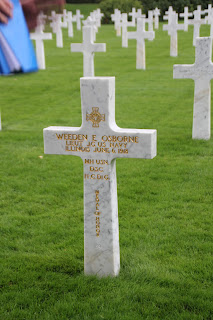
The Aisne-Marne American Cemetery is on the other side of Belleau Woods. Constant Lebastard, assistant superintendent, told us this cemetery gets 40,000 visitors a year. There are 2289 graves here on 42 acres, 250 unknowns, 3 sets of brothers, and one Medal of Honor recipient, Weedon Osbourne. I need to check about the Medal of Honor, Constant told us that it was designed by Tiffany--I had not heard of that before. The sycamore lined walks were beautiful.

After this visit we were in an area where Larry's dad and the 1st Division were. Aged 34, he enlisted as soon as the U.S. declared war. He left the U.S. in October and was gassed in February. Mike told us that the 1st Division was considered Pershing's favorite. They saw heavy fighting. At one point the 18th Infantry regiment (Larry's dad's) were fighting next to the French Foreign Legion. The Legion considered it an honor to fight with the 18th Infantry. The 1st Division had 9000 casualties in 5 days.
In Berzy le Sec we saw a 12th century chateau in ruins from shelling in World War I which the Germans used as a fort. A church was nearby, San Quentin, celebrating 1700 years (I believe the church was built on a 4th century monastery).

We drove on to Roissy and our hotel and our farewell dinner. We have shared this tour with the most delightful people one can imagine. Not only did we all share a common interest, we enjoyed each other's company. Mike even said we were the closest tour group he has had in twenty years.
An anecdote: Our bus driver, congenial Pieter, was truly skilled. He was a sweet 28 year old from the Netherlands with a good sense of humor One day Mike told Pieter to drive the bus down what he thought was a road to see a special site. However it must have been sort of a driveway with no where to turn a 45 passenger bus around. That meant that Pieter had to back the bus up the whole long length he had driven down. That backward drive took 15 minutes of backing up! And I said it like that to emphasize the skill! Last year I backed up for 10 yards in my new car last year at a cousin's country house and hit a pile of rocks.
TK's Takes: He spotted a golf course, Golf de Champagne on the way to the Oise-Aisne American Cemetery. This was the first golf course that he noticed.
Roissy/Villepinte, France
August 23, 2015
The nine day pace was quite rigorous! As we left Reims today Mike reminded us that this city was 80% leveled and the Cathedral was an easy target. We headed for the areas of the 2nd Battle of the Marne.
Some of the emphasis today was the Second Battle of the Marne. Our first stop was an area where Theodore Roosevelt's son, Quentin, was honored. Quentin Roosevelt was in the U.S. Army Air Service where he became a pursuit pilot during World War I. Considered the most famous American to die in the war, he was killed in aerial combat July 14, 1918, and buried near Chamery. The crash site was in the distance. Another of Roosevelt’s sons, Ted Jr., would later be the oldest American soldier and highest ranking officer to land by sea in Normandy (Utah Beach) on D-Day June 6, 1944. He died of a heart attack five weeks into the invasion. The two brothers are now buried side by side at the Normandy American Cemetery above Omaha Beach.
At 9 a.m. we pulled into the Oise-Aisne American Military Cemetery which is located in Seringes-et-Nesles. It was created on the spot where the 42nd American Division, “Rainbow Division” fought. Among the 6,012 graves is that of the poet Joyce Kilmer, a sergeant in the 165th Regiment (42nd Division), who was killed on July 3. 1918. Seven pairs of brothers were buried here.

Joyce Kilmer's grave at Oise-Marne
We headed to the Hill 134 site and walked to the crest of a ridge where Kathy's great uncle, 42nd Division, was wounded in a gas attack near the Ourcq River. Her great uncle and others were taken to a hospital that was soon shelled by the Germans. He experienced shrapnel to the knee and his leg was amputated. Kathy read from a letter that he wrote home, "Don't worry." Then she read the letter from the Red Cross to the family explaining that he had died, that everyone loved him, and that he was buried with full military honors. This was an incredibly moving time, to be with Kathy and hear her read the letters right on the site of the conflict.

Kathy at the crest of the hill


We spent some moments at the very poignant
42nd Division Memorial at the Croix Rouge Farm.
Again we were listening to Kathy speak of her grandfather, William, who was in the 3rd Division, 4th Infantry, Co. L. We were on the hill where his unit was pushing up. The Marne River was to our back. William was career Army and had joined in 1912 at the age of 17. ON July 24 he was gassed and had a concussion. He was transferred to a hospital and never returned to the Front. Because he spoke German, Mike speculated that he was part of a team that was systematically visiting POW camps. Kathy shared photos that her grandfather took of various towns and other sites, photos the family never understood how he had been so many places. Our guide Mike solved that mystery!
We had lunch today at McDonald's. Even though the menu was basically the same as in the U.S. some still had challenges ordering.

Happy Meal menu at McDonald's

American Monument de la Cote 204
We stopped at the American Monument De La Cote 204, “a lasting symbol of
friendship and cooperation between the French and Americans. It is considered
stripped classical in design and on its west facade are sculptured figures
representing the United States and France.

Marine 3rd Division Memorial at Belleau Woods
The Aisne-Marne American Cemetery is on the other side of Belleau Woods. Constant Lebastard, assistant superintendent, told us this cemetery gets 40,000 visitors a year. There are 2289 graves here on 42 acres, 250 unknowns, 3 sets of brothers, and one Medal of Honor recipient, Weedon Osbourne. I need to check about the Medal of Honor, Constant told us that it was designed by Tiffany--I had not heard of that before. The sycamore lined walks were beautiful.

Medal of Honor Recipient, Weedon Osbourne's grave
Tiffany Medal of Honor
After this visit we were in an area where Larry's dad and the 1st Division were. Aged 34, he enlisted as soon as the U.S. declared war. He left the U.S. in October and was gassed in February. Mike told us that the 1st Division was considered Pershing's favorite. They saw heavy fighting. At one point the 18th Infantry regiment (Larry's dad's) were fighting next to the French Foreign Legion. The Legion considered it an honor to fight with the 18th Infantry. The 1st Division had 9000 casualties in 5 days.
In Berzy le Sec we saw a 12th century chateau in ruins from shelling in World War I which the Germans used as a fort. A church was nearby, San Quentin, celebrating 1700 years (I believe the church was built on a 4th century monastery).

Berzy-le-Sec's chateau in ruins and the San Quentin church
We drove on to Roissy and our hotel and our farewell dinner. We have shared this tour with the most delightful people one can imagine. Not only did we all share a common interest, we enjoyed each other's company. Mike even said we were the closest tour group he has had in twenty years.
An anecdote: Our bus driver, congenial Pieter, was truly skilled. He was a sweet 28 year old from the Netherlands with a good sense of humor One day Mike told Pieter to drive the bus down what he thought was a road to see a special site. However it must have been sort of a driveway with no where to turn a 45 passenger bus around. That meant that Pieter had to back the bus up the whole long length he had driven down. That backward drive took 15 minutes of backing up! And I said it like that to emphasize the skill! Last year I backed up for 10 yards in my new car last year at a cousin's country house and hit a pile of rocks.
TK's Takes: He spotted a golf course, Golf de Champagne on the way to the Oise-Aisne American Cemetery. This was the first golf course that he noticed.
Saturday, August 22, 2015
THE LAST SITES OF THE MEUSE-ARGONNE OFFENSIVE, THE MOST IMPORTANT BATTLE OF WORLD WAR I
Holiday
Inn-Reims
Reims,
France
August
22, 2015
This
has surely been a serious blog! I appreciate Mike Hanlon of
www.worldwar1.com /Valor
Tours for his sincere interest in ensuring that we have had a great
tour. His detailed knowledge of every site, including the ones we
didn't see is phenomenal. Every day we pass a minimum of 15 villages,
each with a story to tell. We have been in the Meuse-Argonne Sector
the last three days covering mostly 1918 battle sites and stories,
but some 1916 stories/sites as well. He is able to juggle all of that
seamlessly. The Meuse-Argonne area is mostly a "Hot Zone" because so many engagements took place there. Mike has also been able
to point out some battle sites from the Franco Prussian War,
Napoleon's battles, and Attila the Hun sites. France has seen its
share of wars.
This
morning Mike had breakfast with me to discuss the sites we would be
going to today that would be Archie's 90th Division
engagements. He likes to review what the letters say and how he is
going to intertwine Archie's letters with the specific area of the
90th Division. He has done that with Kathy, John, and
Larry too. Mike and I also talked about audience for my writing and a
possible approach. He mentioned that he has seen many many Great War
letters. Fortunately I already knew there were a lot, but every story
is important.
We left
Verdun at 8 a.m sharp and headed to the U.S. Meuse-Argonne Cemetery
where 14,246 soldiers are buried, including 9 Medal of Honor
recipients, 486 unknowns, 954 missing in action, and 18 sets of brothers. We met David Bedford, the superintendent of the cemetery, who told us that 26,000
American soldiers were killed in this sector in 6 weeks. He spoke of the history of the cemetery and the
layout. The cemetery encompasses 130.5 acres. This is the largest American World War I cemetery in Europe. The Meuse Argonne Offensive was the largest American battle in Europe and is still the largest conflict in U.S. history.
David told us that 40% of Americans who died in this war were buried in Europe, 60% of Americans who died were repatriated to the U.S. Six thousand Gold Star mothers visited the European cemeteries in the middle of the Depression. It was only right that mothers see where their beloved sons were buried.
(Note: the offensive took place between the Meuse River and the Argonne Forest. I need to add a disclaimer on every page of this blog. I was taking notes while Mike was talking, plus I did a lot of reading in the past several years, but I am not a historian and some information may not be totally accurate. I will strive to correct discrepancies)
David told us that 40% of Americans who died in this war were buried in Europe, 60% of Americans who died were repatriated to the U.S. Six thousand Gold Star mothers visited the European cemeteries in the middle of the Depression. It was only right that mothers see where their beloved sons were buried.
(Note: the offensive took place between the Meuse River and the Argonne Forest. I need to add a disclaimer on every page of this blog. I was taking notes while Mike was talking, plus I did a lot of reading in the past several years, but I am not a historian and some information may not be totally accurate. I will strive to correct discrepancies)
We laid
the beautiful red, white, and blue floral spray that we ordered in
Verdun at the gravestone of Harvey Tatum, 29th Division,
116th Infantry Regiment, Virginia. That was John's
father's regiment and he was from Virginia. Our words, written on the
spray's ribbon, were, “Remembrance from your Countrymen, 22 August
2015.” Susan, John's dear wife, beautifully read a poem by
Siegfried Sassoon, “Aftermath.”

Maureen and Mary Jane with the floral spray for placement
at the Meuse-Argonne American Cemetery

We went
on to the chapel and saw a few more graves. I noted that there were
at least 4 men listed on the Missing in Action wall who were in
Archie's Company K, 357th Regiment, 90th
Division.
In another letter, dated December 26, 1918, Archie wrote that he did not send a Christmas package coupon home so that the family could send him a package for Christmas, "as I expected to be pushing up daisies long ago."
After seeing so many cemeteries and memorials, the battle sites, the terrain, I can see why Archie felt this way. It is difficult to think about how much peril Archie and all the men were in, death surrounding them.

This map, engraved into the marble at the Meuse-Argonne American Cemetery,
shows the sector that the 90th Division was in.
In the past, when I would read the names of the villages in France that Archie was in (like Stenay, Baalon, Montmedy) and saw action, I never imagined that I would actually be in those villages. Today when I read the letter sent to Archie by an officer describing the action near Baalon, we were actually looking at the ridge the officer was talking about. My fellow tour friends truly appreciate the connection we each have to this area.

Today we also visited the crash site of "Balloon Buster," Frank Luke, America's second highest scoring air ace during World War I. Another site we saw was the burial site of Roland Garros, a French pilot killed in action in the Champagne. The French National Tennis Center is named for Garros, an amateur tennis champion. [information taken from material that Mike Hanlon provided]
We ended up in Reims for the night. Tim and I took a walk on the "boulevard" before dinner. We were so thirsty we had two large sodas at Burger King. After drinking those, we went back inside and ordered "la meme chose," the same thing all over again!

MJ on the boulevard near the Holiday Inn
We had an excellent dinner outdoors with our tour friends at Le Cafe de Reims.

Our Holiday Inn in Reims, France
TK's Takes: Tim has remarked about the vast farms we are seeing--huge farm equipment, fields of corn, bales of hay and straw already, other crops, seemingly endless in the battle fertile areas of France that we have covered.

Farmland in the Meuse-Argonne area
p.s. Thank you Writer Friend V, et al!
Subscribe to:
Posts (Atom)