It has been a week since we finished our World War I tour in France and I am still on the tour in my dreams every night since. That has never happened before.
Today I reworked the blog of Friday, August 21, 2015, because I wanted to tell the story of the Ossuary of Douaumont. In reflection, the visit to the Ossuary was probably one of the most compelling.
Sunday, August 30, 2015

Friday, August 28, 2015
RECURRING DREAMS, MORE UPDATES
Today I updated our Saturday tour (August 22, 2015) with photos and more information. Every night since our return I am still dreaming that we are on our bus touring the French countryside and battle sites. I know the dreams are occurring because this trip made such an impact on me.
I am so grateful that Tim went with me. We shared so much on this trip. I miss our tour mates very much, too. On Wednesday when we had lunch with my brother Bill and Marge, I appreciated their interest in the trip. I look forward to seeing the book that my brother has about the 28th Division.
Today I reviewed the Second Battle of the Marne, the St. Mihiel and Meuse-Argonne Engagements--now I understand so much more about these areas.
I am so grateful that Tim went with me. We shared so much on this trip. I miss our tour mates very much, too. On Wednesday when we had lunch with my brother Bill and Marge, I appreciated their interest in the trip. I look forward to seeing the book that my brother has about the 28th Division.
Today I reviewed the Second Battle of the Marne, the St. Mihiel and Meuse-Argonne Engagements--now I understand so much more about these areas.
Wednesday, August 26, 2015
UPDATE AND NEW DISCOVERY
Erie, Pennsylvania
August 26, 2015
We arrived home safely at about 5 p.m. DST on Monday. The ease of going to the CDG airport by taxi and our flight were probably the best experience flying we ever had! We had been up 21 hours before we finally went to bed.
Today, Wednesday I think we are just about back to normal and I have begun reviewing my notes and photos and organizing everything. We had an extraordinary trip. I loved being back in France, our new tour friends, our tour guide Mike Hanlon, all that we learned, and Tim's engagement in the whole experience.
Also today I discovered that my Uncle Roy, my mother's only brother, was in the 28th Division. I knew he was in the 112th Infantry out of Cambridge Springs, Pennsylvania, but I did not know he was in the 28th. If only I had done that research before I left. Mike could have given me more information about where his division/regiment was. I am upset at myself for this. On the bright side, I know that we were in Chateau Thierry, as was Uncle Roy. My brother found a book that focused on Uncle Roy's Regiment and Division.

I have updated Sunday, August 23, because there was so much to say. I plan to update Saturday, August 22, 2015 tomorrow. Now that I am home at my desktop I can more easily add photos and text. I am grateful though for my Gateway 10.1 inch Touch laptop. It was so much easier to carry and certainly served its purpose.
August 26, 2015
We arrived home safely at about 5 p.m. DST on Monday. The ease of going to the CDG airport by taxi and our flight were probably the best experience flying we ever had! We had been up 21 hours before we finally went to bed.
Today, Wednesday I think we are just about back to normal and I have begun reviewing my notes and photos and organizing everything. We had an extraordinary trip. I loved being back in France, our new tour friends, our tour guide Mike Hanlon, all that we learned, and Tim's engagement in the whole experience.
Also today I discovered that my Uncle Roy, my mother's only brother, was in the 28th Division. I knew he was in the 112th Infantry out of Cambridge Springs, Pennsylvania, but I did not know he was in the 28th. If only I had done that research before I left. Mike could have given me more information about where his division/regiment was. I am upset at myself for this. On the bright side, I know that we were in Chateau Thierry, as was Uncle Roy. My brother found a book that focused on Uncle Roy's Regiment and Division.

Roy Hall back from World War I,
holding his new sister--my mother, born 10 Apr 1919.
Bear Lake, Pennsylvania
I have updated Sunday, August 23, because there was so much to say. I plan to update Saturday, August 22, 2015 tomorrow. Now that I am home at my desktop I can more easily add photos and text. I am grateful though for my Gateway 10.1 inch Touch laptop. It was so much easier to carry and certainly served its purpose.
Sunday, August 23, 2015
THE SECOND BATTLE OF THE MARNE/FAREWELL DINNER
The Golden Tulip
Roissy/Villepinte, France
August 23, 2015
The nine day pace was quite rigorous! As we left Reims today Mike reminded us that this city was 80% leveled and the Cathedral was an easy target. We headed for the areas of the 2nd Battle of the Marne.
Some of the emphasis today was the Second Battle of the Marne. Our first stop was an area where Theodore Roosevelt's son, Quentin, was honored. Quentin Roosevelt was in the U.S. Army Air Service where he became a pursuit pilot during World War I. Considered the most famous American to die in the war, he was killed in aerial combat July 14, 1918, and buried near Chamery. The crash site was in the distance. Another of Roosevelt’s sons, Ted Jr., would later be the oldest American soldier and highest ranking officer to land by sea in Normandy (Utah Beach) on D-Day June 6, 1944. He died of a heart attack five weeks into the invasion. The two brothers are now buried side by side at the Normandy American Cemetery above Omaha Beach.
At 9 a.m. we pulled into the Oise-Aisne American Military Cemetery which is located in Seringes-et-Nesles. It was created on the spot where the 42nd American Division, “Rainbow Division” fought. Among the 6,012 graves is that of the poet Joyce Kilmer, a sergeant in the 165th Regiment (42nd Division), who was killed on July 3. 1918. Seven pairs of brothers were buried here.

We headed to the Hill 134 site and walked to the crest of a ridge where Kathy's great uncle, 42nd Division, was wounded in a gas attack near the Ourcq River. Her great uncle and others were taken to a hospital that was soon shelled by the Germans. He experienced shrapnel to the knee and his leg was amputated. Kathy read from a letter that he wrote home, "Don't worry." Then she read the letter from the Red Cross to the family explaining that he had died, that everyone loved him, and that he was buried with full military honors. This was an incredibly moving time, to be with Kathy and hear her read the letters right on the site of the conflict.


Again we were listening to Kathy speak of her grandfather, William, who was in the 3rd Division, 4th Infantry, Co. L. We were on the hill where his unit was pushing up. The Marne River was to our back. William was career Army and had joined in 1912 at the age of 17. ON July 24 he was gassed and had a concussion. He was transferred to a hospital and never returned to the Front. Because he spoke German, Mike speculated that he was part of a team that was systematically visiting POW camps. Kathy shared photos that her grandfather took of various towns and other sites, photos the family never understood how he had been so many places. Our guide Mike solved that mystery!
We had lunch today at McDonald's. Even though the menu was basically the same as in the U.S. some still had challenges ordering.


We stopped briefly in Belleau Woods, an area of one square mile. The Battle of Belleau Wood (1–26 June 1918) occurred during the German 1918 Spring Offensive in World War I, near the Marne River in France. The battle was fought between U.S. Army and Third Marine divisions along with French and British forces against an assortment of German units. This battle site is especially honored by the United States Marine Corps where the Marine Corps began their modern history. There were signs of trenches in the forest of very old trees. Some German artillery are still at the site.

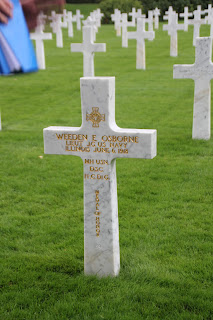
The Aisne-Marne American Cemetery is on the other side of Belleau Woods. Constant Lebastard, assistant superintendent, told us this cemetery gets 40,000 visitors a year. There are 2289 graves here on 42 acres, 250 unknowns, 3 sets of brothers, and one Medal of Honor recipient, Weedon Osbourne. I need to check about the Medal of Honor, Constant told us that it was designed by Tiffany--I had not heard of that before. The sycamore lined walks were beautiful.

After this visit we were in an area where Larry's dad and the 1st Division were. Aged 34, he enlisted as soon as the U.S. declared war. He left the U.S. in October and was gassed in February. Mike told us that the 1st Division was considered Pershing's favorite. They saw heavy fighting. At one point the 18th Infantry regiment (Larry's dad's) were fighting next to the French Foreign Legion. The Legion considered it an honor to fight with the 18th Infantry. The 1st Division had 9000 casualties in 5 days.
In Berzy le Sec we saw a 12th century chateau in ruins from shelling in World War I which the Germans used as a fort. A church was nearby, San Quentin, celebrating 1700 years (I believe the church was built on a 4th century monastery).

We drove on to Roissy and our hotel and our farewell dinner. We have shared this tour with the most delightful people one can imagine. Not only did we all share a common interest, we enjoyed each other's company. Mike even said we were the closest tour group he has had in twenty years.
An anecdote: Our bus driver, congenial Pieter, was truly skilled. He was a sweet 28 year old from the Netherlands with a good sense of humor One day Mike told Pieter to drive the bus down what he thought was a road to see a special site. However it must have been sort of a driveway with no where to turn a 45 passenger bus around. That meant that Pieter had to back the bus up the whole long length he had driven down. That backward drive took 15 minutes of backing up! And I said it like that to emphasize the skill! Last year I backed up for 10 yards in my new car last year at a cousin's country house and hit a pile of rocks.
TK's Takes: He spotted a golf course, Golf de Champagne on the way to the Oise-Aisne American Cemetery. This was the first golf course that he noticed.
Roissy/Villepinte, France
August 23, 2015
The nine day pace was quite rigorous! As we left Reims today Mike reminded us that this city was 80% leveled and the Cathedral was an easy target. We headed for the areas of the 2nd Battle of the Marne.
Some of the emphasis today was the Second Battle of the Marne. Our first stop was an area where Theodore Roosevelt's son, Quentin, was honored. Quentin Roosevelt was in the U.S. Army Air Service where he became a pursuit pilot during World War I. Considered the most famous American to die in the war, he was killed in aerial combat July 14, 1918, and buried near Chamery. The crash site was in the distance. Another of Roosevelt’s sons, Ted Jr., would later be the oldest American soldier and highest ranking officer to land by sea in Normandy (Utah Beach) on D-Day June 6, 1944. He died of a heart attack five weeks into the invasion. The two brothers are now buried side by side at the Normandy American Cemetery above Omaha Beach.
At 9 a.m. we pulled into the Oise-Aisne American Military Cemetery which is located in Seringes-et-Nesles. It was created on the spot where the 42nd American Division, “Rainbow Division” fought. Among the 6,012 graves is that of the poet Joyce Kilmer, a sergeant in the 165th Regiment (42nd Division), who was killed on July 3. 1918. Seven pairs of brothers were buried here.

Joyce Kilmer's grave at Oise-Marne
We headed to the Hill 134 site and walked to the crest of a ridge where Kathy's great uncle, 42nd Division, was wounded in a gas attack near the Ourcq River. Her great uncle and others were taken to a hospital that was soon shelled by the Germans. He experienced shrapnel to the knee and his leg was amputated. Kathy read from a letter that he wrote home, "Don't worry." Then she read the letter from the Red Cross to the family explaining that he had died, that everyone loved him, and that he was buried with full military honors. This was an incredibly moving time, to be with Kathy and hear her read the letters right on the site of the conflict.

Kathy at the crest of the hill


We spent some moments at the very poignant
42nd Division Memorial at the Croix Rouge Farm.
Again we were listening to Kathy speak of her grandfather, William, who was in the 3rd Division, 4th Infantry, Co. L. We were on the hill where his unit was pushing up. The Marne River was to our back. William was career Army and had joined in 1912 at the age of 17. ON July 24 he was gassed and had a concussion. He was transferred to a hospital and never returned to the Front. Because he spoke German, Mike speculated that he was part of a team that was systematically visiting POW camps. Kathy shared photos that her grandfather took of various towns and other sites, photos the family never understood how he had been so many places. Our guide Mike solved that mystery!
We had lunch today at McDonald's. Even though the menu was basically the same as in the U.S. some still had challenges ordering.

Happy Meal menu at McDonald's

American Monument de la Cote 204
We stopped at the American Monument De La Cote 204, “a lasting symbol of
friendship and cooperation between the French and Americans. It is considered
stripped classical in design and on its west facade are sculptured figures
representing the United States and France.

Marine 3rd Division Memorial at Belleau Woods
The Aisne-Marne American Cemetery is on the other side of Belleau Woods. Constant Lebastard, assistant superintendent, told us this cemetery gets 40,000 visitors a year. There are 2289 graves here on 42 acres, 250 unknowns, 3 sets of brothers, and one Medal of Honor recipient, Weedon Osbourne. I need to check about the Medal of Honor, Constant told us that it was designed by Tiffany--I had not heard of that before. The sycamore lined walks were beautiful.

Medal of Honor Recipient, Weedon Osbourne's grave
Tiffany Medal of Honor
After this visit we were in an area where Larry's dad and the 1st Division were. Aged 34, he enlisted as soon as the U.S. declared war. He left the U.S. in October and was gassed in February. Mike told us that the 1st Division was considered Pershing's favorite. They saw heavy fighting. At one point the 18th Infantry regiment (Larry's dad's) were fighting next to the French Foreign Legion. The Legion considered it an honor to fight with the 18th Infantry. The 1st Division had 9000 casualties in 5 days.
In Berzy le Sec we saw a 12th century chateau in ruins from shelling in World War I which the Germans used as a fort. A church was nearby, San Quentin, celebrating 1700 years (I believe the church was built on a 4th century monastery).

Berzy-le-Sec's chateau in ruins and the San Quentin church
We drove on to Roissy and our hotel and our farewell dinner. We have shared this tour with the most delightful people one can imagine. Not only did we all share a common interest, we enjoyed each other's company. Mike even said we were the closest tour group he has had in twenty years.
An anecdote: Our bus driver, congenial Pieter, was truly skilled. He was a sweet 28 year old from the Netherlands with a good sense of humor One day Mike told Pieter to drive the bus down what he thought was a road to see a special site. However it must have been sort of a driveway with no where to turn a 45 passenger bus around. That meant that Pieter had to back the bus up the whole long length he had driven down. That backward drive took 15 minutes of backing up! And I said it like that to emphasize the skill! Last year I backed up for 10 yards in my new car last year at a cousin's country house and hit a pile of rocks.
TK's Takes: He spotted a golf course, Golf de Champagne on the way to the Oise-Aisne American Cemetery. This was the first golf course that he noticed.
Saturday, August 22, 2015
THE LAST SITES OF THE MEUSE-ARGONNE OFFENSIVE, THE MOST IMPORTANT BATTLE OF WORLD WAR I
Holiday
Inn-Reims
Reims,
France
August
22, 2015
This
has surely been a serious blog! I appreciate Mike Hanlon of
www.worldwar1.com /Valor
Tours for his sincere interest in ensuring that we have had a great
tour. His detailed knowledge of every site, including the ones we
didn't see is phenomenal. Every day we pass a minimum of 15 villages,
each with a story to tell. We have been in the Meuse-Argonne Sector
the last three days covering mostly 1918 battle sites and stories,
but some 1916 stories/sites as well. He is able to juggle all of that
seamlessly. The Meuse-Argonne area is mostly a "Hot Zone" because so many engagements took place there. Mike has also been able
to point out some battle sites from the Franco Prussian War,
Napoleon's battles, and Attila the Hun sites. France has seen its
share of wars.
This
morning Mike had breakfast with me to discuss the sites we would be
going to today that would be Archie's 90th Division
engagements. He likes to review what the letters say and how he is
going to intertwine Archie's letters with the specific area of the
90th Division. He has done that with Kathy, John, and
Larry too. Mike and I also talked about audience for my writing and a
possible approach. He mentioned that he has seen many many Great War
letters. Fortunately I already knew there were a lot, but every story
is important.
We left
Verdun at 8 a.m sharp and headed to the U.S. Meuse-Argonne Cemetery
where 14,246 soldiers are buried, including 9 Medal of Honor
recipients, 486 unknowns, 954 missing in action, and 18 sets of brothers. We met David Bedford, the superintendent of the cemetery, who told us that 26,000
American soldiers were killed in this sector in 6 weeks. He spoke of the history of the cemetery and the
layout. The cemetery encompasses 130.5 acres. This is the largest American World War I cemetery in Europe. The Meuse Argonne Offensive was the largest American battle in Europe and is still the largest conflict in U.S. history.
David told us that 40% of Americans who died in this war were buried in Europe, 60% of Americans who died were repatriated to the U.S. Six thousand Gold Star mothers visited the European cemeteries in the middle of the Depression. It was only right that mothers see where their beloved sons were buried.
(Note: the offensive took place between the Meuse River and the Argonne Forest. I need to add a disclaimer on every page of this blog. I was taking notes while Mike was talking, plus I did a lot of reading in the past several years, but I am not a historian and some information may not be totally accurate. I will strive to correct discrepancies)
David told us that 40% of Americans who died in this war were buried in Europe, 60% of Americans who died were repatriated to the U.S. Six thousand Gold Star mothers visited the European cemeteries in the middle of the Depression. It was only right that mothers see where their beloved sons were buried.
(Note: the offensive took place between the Meuse River and the Argonne Forest. I need to add a disclaimer on every page of this blog. I was taking notes while Mike was talking, plus I did a lot of reading in the past several years, but I am not a historian and some information may not be totally accurate. I will strive to correct discrepancies)
We laid
the beautiful red, white, and blue floral spray that we ordered in
Verdun at the gravestone of Harvey Tatum, 29th Division,
116th Infantry Regiment, Virginia. That was John's
father's regiment and he was from Virginia. Our words, written on the
spray's ribbon, were, “Remembrance from your Countrymen, 22 August
2015.” Susan, John's dear wife, beautifully read a poem by
Siegfried Sassoon, “Aftermath.”

Maureen and Mary Jane with the floral spray for placement
at the Meuse-Argonne American Cemetery

We went
on to the chapel and saw a few more graves. I noted that there were
at least 4 men listed on the Missing in Action wall who were in
Archie's Company K, 357th Regiment, 90th
Division.
In another letter, dated December 26, 1918, Archie wrote that he did not send a Christmas package coupon home so that the family could send him a package for Christmas, "as I expected to be pushing up daisies long ago."
After seeing so many cemeteries and memorials, the battle sites, the terrain, I can see why Archie felt this way. It is difficult to think about how much peril Archie and all the men were in, death surrounding them.

This map, engraved into the marble at the Meuse-Argonne American Cemetery,
shows the sector that the 90th Division was in.
In the past, when I would read the names of the villages in France that Archie was in (like Stenay, Baalon, Montmedy) and saw action, I never imagined that I would actually be in those villages. Today when I read the letter sent to Archie by an officer describing the action near Baalon, we were actually looking at the ridge the officer was talking about. My fellow tour friends truly appreciate the connection we each have to this area.

Today we also visited the crash site of "Balloon Buster," Frank Luke, America's second highest scoring air ace during World War I. Another site we saw was the burial site of Roland Garros, a French pilot killed in action in the Champagne. The French National Tennis Center is named for Garros, an amateur tennis champion. [information taken from material that Mike Hanlon provided]
We ended up in Reims for the night. Tim and I took a walk on the "boulevard" before dinner. We were so thirsty we had two large sodas at Burger King. After drinking those, we went back inside and ordered "la meme chose," the same thing all over again!

MJ on the boulevard near the Holiday Inn
We had an excellent dinner outdoors with our tour friends at Le Cafe de Reims.

Our Holiday Inn in Reims, France
TK's Takes: Tim has remarked about the vast farms we are seeing--huge farm equipment, fields of corn, bales of hay and straw already, other crops, seemingly endless in the battle fertile areas of France that we have covered.

Farmland in the Meuse-Argonne area
p.s. Thank you Writer Friend V, et al!
Friday, August 21, 2015
THE MEUSE ARGONNE OFFENSIVE, CONTINUED
Hotel
St. Paul
Verdun,
France
August
21, 2015
One of
the many emotional parts of the day was when we viewed the areas of Bois
de Forges, Molleville Farm, and Brabant sur Meuse. John read
one of his father's letters. His father was in the 29th
Division, 116th Regiment, Co. B. This division experienced
6000 casualties in 23 days. [Note: There are approximately 28,000 men
in a division].
The
Germans, realizing the need to succeed, used heavy equipment and gas
to defend their position—the fighting in this area was only about
30-40 miles from the German border. The eve before this engagement,
John's father wrote that he was using a gas mask as a desk, there
were big guns roaring and the air was full of battle planes. He also
wrote that he was sore from hiking. We moved the bus to another
position of the 29th Division and John read again, “I've
had my share of fighting.” John's father wrote of the dense forest
and fighting like old time Indian fighting. He said he carried his
best friend off the battlefield. John's father also said that he laid
in a shell hole one whole day while being shot at. His friend did not
survive. [Note: I am paraphrasing and may not have done the letter
justice].
John
has typed all of his father's letters and compiled a history for his
family that he shared with us. It is interesting to see parallel
stories of the same time period.
Leaving the area of Molleville Farm and Bois de la Grande Montagne, we could see the Woevre Plain and the Rhine River behind that.
Leaving the area of Molleville Farm and Bois de la Grande Montagne, we could see the Woevre Plain and the Rhine River behind that.
There
were many other stops:
Flabas—an
interesting story of how putting a POW camp on the front line
results in the enemy killing their own soldiers as they fired.The story of Lt. Col Driant—the first hero of Verdun. His unit was closest to the Germans and could hear them working in the night. The unit warned Verdun. Finally they had to withdraw. Driant gave his groom his wedding ring to give to his wife if he was killed. A few days later their position was untenable and Driant was killed. He was buried with unknowns from his unit.

Lt. Col. Driant's Tomb
Battle of Verdun—fought for over 300 nights and days—February 21 to December 25, the longest battle of the war. There were 378,000 French Casualties and 333,000 German casualties (casualties=dead and wounded). The greatest, but most exhausting French victory of World War I.
Fort Douaumont—the largest fort in the world, covers much land and is three stories high. It was truly a fortification. The construction was an aggregate of cement and stones, obviously very solid. The fort was captured early by the Germans, a perfect observation post for the Verdun battlefield.

Fort Douaumont

Fort Douaumont

Fort Douaumont
Site of Fleury—one of the nine totally destroyed villages, the most famous. It is designated as a "village that died for France." It was in the hottest zone of Verdun and the area changed hands 14 times in war. Now the village is basically nothing but shell pits. Posts mark the school, the farmhouses, the town hall, the grocery, the baker, the carpenter, the shoemaker, and more. One sign indicated that the soil retained the memory of havoc wreaked by artillery from both sides. An interesting fact that I read on a sign on the small chapel built here: Bavarians fought at this site and some Bavarian villages named streets after Fleury.

Fleury

Memorial at Fleury-devant-Douaumont
Destroyed French villages:
Beaumont-en-Verdunois
Bezonvaux
Cumieres-le-Mort-Homme
Douaumont
Fleury-devant-Douaumont
Haumont-pres-Samogneux
Louvemont-Cote-du-Poivre
Ornes
Vaux-devant-Damloup
L'Ossuaire de Douaumont / The
Ossuary of Douaumont was one of the most spiritual and
meaningful stops of our whole trip. This sacred memorial
contains the remains of soldiers who died on the battlefield during the
Battle of Verdun in World War I. From literature at the memorial, "Approximately 230,000 men died out of a total
of 700,000 casualties (dead, wounded and missing). The battle became known in
German as Die Hölle von Verdun (English: The Hell of Verdun),
or in French as L'Enfer de Verdun, and was conducted on a
battlefield covering less than 7.7 sq miles. Both French and Germans are buried here-the remains would be indistinguishable--and some Americans too.

The tower is shaped like an artillery shell, but is cathedral-like with Christian images. When we stepped inside the building, the silence was remarkable. It was cool inside on a hot day. Thousands of names are engraved on the walls. Inside the chapel the stained glass windows depicted stunning images of battlefields with crosses. One window depicts two angels holding a nurse (red cross on her veil) who was wounded in the war when a hospital was bombarded. Another image is of Christ cradling a soldier. The Crucifix at the Altar is Mary holding Christ upright, both have arms outstretched to form a cross, an image I have never seen.
We walked along the exterior of the memorial and did not realize that the skeletal remains of at least 130,000 unidentified combatants of both nations could be seen through small outside windows at the lower edge of the building. The largest single French military cemetery of the First World War with 16,142 graves is nearby.
We were able to see a film in English and I tried to write in the dark as we viewed it--the film was so very expressive. These are the words that I captured:
"Mud, gas, shells, death comes.
It is our duty to survive and hold on.
Burnt tree stumps, wire, blood, powder, gas, corpses, shells rain down.
Death mixes with life. The bourgeois and the worker, the chaplain and the free thinker.
Images, not words tell the stories.
Nine villages gone, others ravaged.
Whispers, carnage, man destroyed by machines.
Look! Look at us!
We are 20, we are 30, we represented France.
We represented Germany.
We represented life."
This memorial, L'Ossuaire de Douaumont, truly expresses the carnage of war.
After the Ossuary and after Fleury, we headed back to our hotel in Verdun.
We saw huge farms, so many rocks in the plowed fields. Woods. Hills.
Earlier this day we were talking about engineers--maybe I asked about the 37th Engineers, the unit my Great Uncle Earl was in. Now I wished I knew what Division they were with. I could not find out in a search.
From Wikipedia I did find: "The 37th Engineer Battalion was first activated on 16 January 1918, as 1st Battalion, 37th Engineer Regiment, whose primary function was electrical and mechanical engineering. During World War I, the battalion participated in the Battle of St. Mihiel and the Meuse Argonne Offensive as a member of the American Expeditionary Force. Following the war, the 37th Engineer Regiment was inactivated in March 1919." Mike did say that the 37th worked on electrical and mechanical duties. I have a few letters that Uncle Earl wrote so I will check them. Mike also said that engineers were absolutely essential. Many were killed building or rebuilding bridges. He continued that it was the engineers who slowed everything down for the breakthrough of the Battle of the Bulge in World War II.
"My body to earth, my soul to God, my heart to France."
TK's Takes: He saw a hummingbird nest and reminded me about the nesting swallows just outside the 2nd floor window in our Verdun hotel.
Bon
Soir. I will add though that ferns are speaking to me everywhere---
one stood out in the bright sunlight today at the Colonel Driant memorial and a fern frond was left
at a memorial in Fleury.


Near the Tomb of Lt. Col.Driant
Thursday, August 20, 2015
ARCHIE'S FERN
Hotel
St. Paul
Verdun,
FranceAugust 20, 2015
The
weather was warmer today as we headed by bus nearby to explore the
beginning of the Meuse-Argonne Sector, a 25 mile front. It is the
largest battle in American history, over difficult terrain—with
ridges, the Meuse River, the Argonne Forest, the Aire River, and the
Moselle River. Fought between September 26 to November 11, 1918, this
battle involved 1.2 million soldiers. Six hundred thousand American soldiers were involved in the opening attack.
While
driving, we reviewed maps of the first assaults. We are only about 40
miles from Germany and the area was especially important to the
Germans. First we stopped at a well known monument near Chattancourt,
Le Mort Homme area dedicated to the 69th French
Division—the monument depicts an enrobed skeleton holding a flag
staff. The inscription, “Ils n'ont pas passe,” meaning they did
not pass. The French were determined to take this hill. It is said
that this is a woods where birds never sing. Losses were heavy but
Verdun was saved. The area was reforested because nothing else would
grow there. [Note: We try mostly to stay in the same time period as
we examine battle areas, but Le Mort Homme was 1916]

Back to
the 1918 period, we stopped at a large American monument near
Malancourt, where 600,000 soldiers were involved in the opening
attack of the Meuse Argonne offensive. There were two hundred steps
to the top, but I was more interested in the German observation post
and trenches. An Abbe in ruins from the shelling was behind the
monument, left as is.
Other
areas we visited:
- The site of the Lost Battalion incident (77th Liberty Division from New York)
- A monument to Cher Ami, a carrier pigeon that was wounded but still carried a message out about where the lost battalion was

- Pennsylvania monuments---the state of Pennsylvania had more burials in France from the war than any other state. Three monuments, one especially large (2 acres, both sides of the street in Varenne), were erected by Pennsylvania. (3 PA divisions: 28th, 78th, 79th)

- Exermont near where Larry's father's 1st Division, 18th Regiment was.
- Sergeant York Memorial and the path where he encountered Germans who surrendered to him (he was a Corporal at the time) (Chatel-Chehery (CMOH)

- Flaysville/Clierges (check) where our Uncle Earl's 37th Engineers Division specialized in electrical work.
- Sam Woodfill (CMOH)
I noted the ferns growing along side the road in the forest
areas—they made me think again of the dried fern that Archie either
carried home or sent home. The fern. Did it distract him from the
horrors all around him? Was it a connection to home? A
distraction? Why? A fern, the feathery leaves, the bright green, long
since faded. Was it the rare vegetation you saw amongst the
devastated ruined landscape? Why?
Subscribe to:
Posts (Atom)