Monday, August 13, 2018

OUR DAY ON THE ST. MIHIEL SALIENT, REMEMBERING OUR FAMILY, HONORING WILLIAM HENDERSHOTT

Monday, 13 August 2018
Les Jardins du Mess
Verdun, France
72 F, sunny

One hundred years ago, our countrymen came to France to join the Great War. After brief training, many divisions faced their first big test, the St. Mihiel Offensive in September 1918. Over 500,000 American men and 110,000 French pursued General Pershing’s goal of breaking through the German line to move toward the city of Metz. Despite the constant shelling by the Germans and the air fights, the American attack was successful and served to establish what the American Army could do.

Today we covered the St. Mihiel Salient, the areas that William Hendershott, Arthur Manness, Archie Harvey, Roy Hall, Lynn Price, and Robert Arnold, marched through and fought through, the most horrific battle American forces had ever been in. They pushed through trees, encountered pill boxes, horrific shelling, the explosions, the mud, the smoke, the rubble.

When our bus dropped us off at the Eparges Spur, we saw the remnants of huge mine craters, shell explosions, and trenches. Mike called it a blood soaked battlefield--an area where mines were much used. War had been going on in this area for four years as the Americans came in. It was stunning to see the plain below, the American position.
Remnants of trenches still...

A shell or mine crater-photos do not do them justice because the viewer cannot determine depth

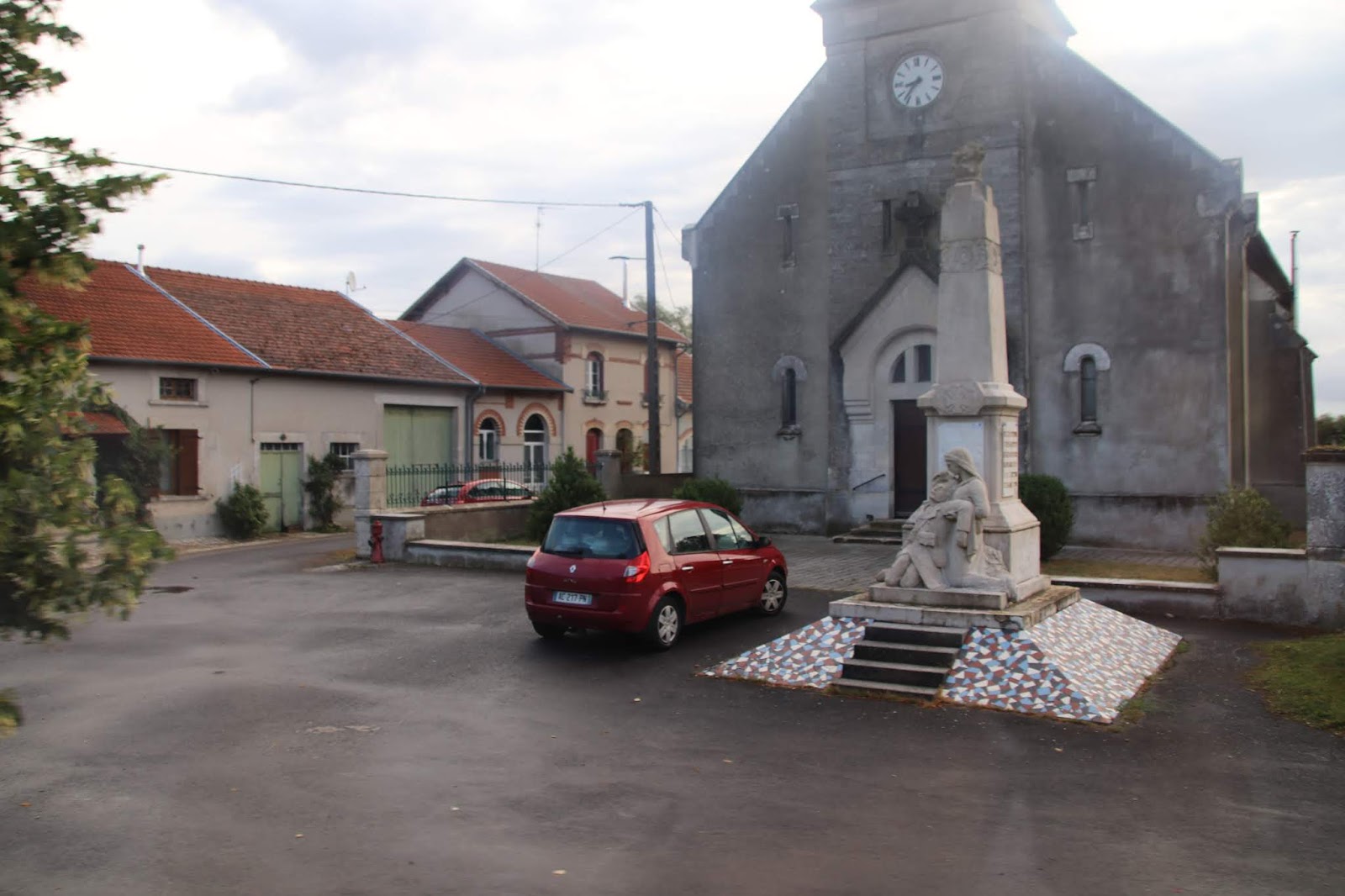
This monument depicts Mother Mary cradling a soldier--another Pieta like pose. Every single village or town in France has at least one statue/monument dedicated to the soldiers of World War I. The art of war.

Our bus continued on as Mike explained each division’s position at St. Mihiel and what happened each day. We learned that George Patton made his name here, the first American use of tanks.  Mike G mentioned there will be a "Patton Day" in September this year in St. Mihiel. We saw "General George Patton Pilsner" beer that is being made in the Czech Republic. I wish I could have purchased a souvenir bottle, but our luggage was already at max!

Mont Sec Monument is one of the most dramatic sites as it sits on one of the highest points in France, a perfect defensive position for the Germans. Today the tall columns can be seen for miles and when one looks out from its platform one can see the grand valley, the sight of such horror in 1918.
Mont Sec Monument

The valley as seen from Mont Sec--in September 1918 over 550,000 Americans and 110,000 French filled this valley. Until the Meuse Argonne Offensive a few weeks later, 
St. Mihiel was considered the laragest battle in U.S. history.

We passed the area of several villages that no longer exist. Other villages and towns were devastated during the war, so the French used the stones to rebuild from the rubble. After the war, Germany was required to pay reparation to rebuild many towns and villages, but not all.


When we reached Euville, Mike had arranged for all of us to have lunch together at Restaurant Le Provencal. Our three course lunch was a petite salad and petite meatloaf-type pate, turkey with mushrooms and creamy potatoes, and cooked julienne carrots, parsnips, and zucchini, with chocolate mousse for dessert. The best meal so far!  We met Mike G and his wife Shannon who are now making their home in France--Mike G is also very knowledgable about the Great War and is considered an American ambassador to St. Mihiel. 

After lunch, we traveled on to St. Mihiel American Cemetery, a beautifully maintained cemetery of 40.5 acres in Thiaucourt, France. The majority of the 4,153 soldiers buried here, as well as the 284 missing in action, died in the St. Mihiel Salient that threatened Paris.


Today we honored both William Hendershott at his gravesite, as well as Arthur Manness. Tim and I felt privileged to do that for the Veterans of Foreign Wars Post #374, named for both of these men from Arcade, New York. Everyone listened as we said a few words of our respect for these men and all of our tour mates, 42 witnessess, shared in a moment of silence and reflection.

The grave of William Hendershott, 78th Division, 303rd Engineer Regiment
St. Mihiel American Cemetery / 2018
William Hendershott's mother in 1932 at the same grave of her son in St. Mihiel American Cemetery

Military Service Veterans Jim C, Tim, Ed M, and Erik K after 
they lowered the flag at St. Mihiel American Cemetery

On the way back to the hotel, tour mate Jim O'D, now a tour guide in San Francisco, gave us a run down on architectural styles of different WW I monuments we have seen. I hope that Jim writes an article about that. For example, the Oise Aisne American Cemetery is in Romanesque style, built in 1919. St. Mihiel American Cemetery is neo-classic. He spoke of the architects and the other work they had done, e.g. one designed the Empire State Building. I am realizing that despite the fact that I took copious notes (87 handwritten pages) during the tour, I did not capture everything.

TK's Takes:

Sunday, August 12, 2018

TANKS, COOTIES, CATHEDRALS, AND HARLEM HELL FIGHTERS

Sunday, 12 August 2018
Les Jardins du Mess
Verdun, France
80s F, sunny

Another sunny day in France! We have been so fortunate with the weather. This is the 6th day of intense touring of sites related to the Great War. Our hotel is the best yet except for Wi-Fi. Baskets of croissants have been available at each hotel so instead of breakfast I take two for the road. Tim has enjoyed the cereal (sort of like Muesli), other breads, and choices of sliced cheese (even Vache Qui Rit), sliced meats, and yogurt. Fresh fruit is always available. Tim says the bacon is not cooked as much as he would like—at each hotel.

Everyone is always on time for the bus departure, which is totally necessary with a group this size. From the beginning, Mike said that the bus horn would be tooted once for all aboard. Twice means the doors are shutting and three toots means, see you later. Understood!

Today we are mostly in the Champagne area of France, around the Marne River.

Tour mate Tim, of Oklahoma, spoke of his grandfather who venerated President Wilson.

The Yankee 26th Division (New England National Guard) was in this area in January 1918. The division was assigned to reinforce the French on the Chemin des Dames front, near Soissons and the Aisne River. The 12 battalions of the Yankee Division were spread across the front. We stopped at Caverne du Dragon, a limestone quarry made into quarters used by the Germans fifty feet below ground. It was closed on Sunday morning, but fortunately we saw this site in 2015. 

Monument at Caverne de Dragon, honoring the Colonial Senegalese soldiers who fought for France

We were near an area we had seen in 2015, the Plateau de Californie, a good offensive position for the Germans and was a resort area before the war. Old Craonne could be seen in the distance. No matter where we are in this whole area of France, Mike tells us we are in this sector or that sector of fighting. For example, now we are in what is called the Champagne sector. Since we are not exactly going in chronological order, I can get confused as to time and order of battles as we travel.

Plateau de Californie--a superior German position


The Champagne Operation was in July 1918 and the aim was to capture the Romagne and Cunel Heights. The 80th (Lynn Price) and the 28th (Roy Hall, Robert Arnold, the Silverthorn Brothers, and Arthur Manness) were in this area and encountered ferocious and dogged resistance and in three days gained only a mile, according to our literature. Mike said that the Champagne area had been a horrible killing ground of the French Army.
World War I technology--the tank

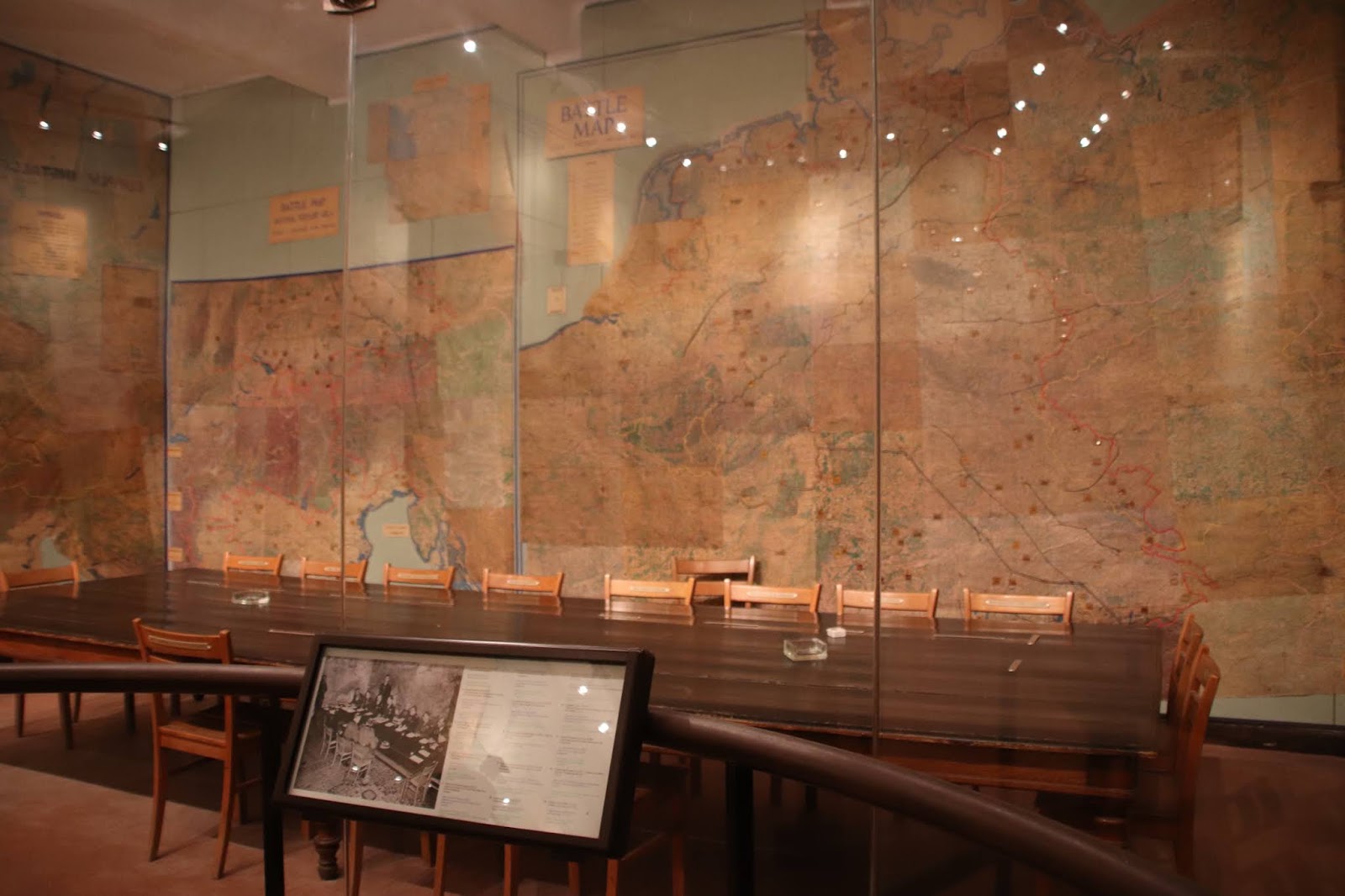
After another lunch at Flunch (love that name—and if this were not such a serious blog I would elaborate on the “Toilettes.” The setup of the one in this Flunch was especially interesting), we visited the Reims Treaty Museum, with the room that the treaty ending World War II was signed. The exhibits in this museum were well done and I was especially interested in the display of World War II uniforms, including the Army Nurse Corps uniform—my mother was a 1st Lieutenant in the U.S. Army Nurse Corps during WW II.

Museum of the Surrender-Reims, France
Treaty of Reims -- World War II


The entire room enclosed in plexiglass where the Treaty/World War II was signed

The Evening News  London, England
07 May 1945

U.S. Army Nurse Corps uniform

Cathedral of Reims, Reims, France


Other sites we saw or stories we  heard---
Navarin Farm—brutal fighting, multiple burials of thousands of French men who gave their lives for France.

Blanc Mont--where American soldiers fought for 24 hours without food or water; more American casualties than Belleau Wood.

The Choctaw Code Talkers-- It was discovered that the Choctaw Indian soldiers from Oklahoma spoke a language that would confuse the Germans.

The Harlem Hellfighters-- One of our tour mates, Ken of NYC, spoke about the Harlem Hell Fighters (369th Infantry Regiment) and their valiant efforts in the Great War. We stopped at a memorial for the 93rd Division, the Harlem Hell Fighters, and Mike told us that the French people from the area visited this memorial after 9-11 to honor the Americans who lost their lives on that day.
Son and father, Steve and Ken, at the monument dedicated to the93rd Division, 369th Infantry Regiment
The Harlem Hellfighters
The French people in the region gathered here after 9-11 in honor of those who perished


We arrived at our hotel in Verdun about 6 p.m. We had pizza at Tour Guide Mike’s favorite restaurant in Verdun, La Toscane, with Mike and Virginia.

 _________________
Friends, it is almost midnight and I just finished my prep for the ceremony at St. Mihiel American Cemetery tomorrow on behalf of VFW Post 374 and all of us on the tour, plus preparing for my sharing of Archie's story, so this is short--our last hotel was great and this one in Verdun is super too.  Restaurants open at 7 p.m. and the French eat at a much slower pace (and serve food that way too), so we did not return to the hotel until about 9:30-10 p.m. I wanted my prep printed and discovered that I had to set the paper size at A4 to accommodate French printers. Oh my. I need sleep!

Tim checked out the turnips.

Saturday, August 11, 2018

KEYSTONE DIVISION, SECOND BATTLE OF THE MARNE, A WITNESS TO REMEMBRANCE

Saturday, 11 August 2018
Best Western Plus, Hotel des Francs
Soissons, France
70s F, sunny

First, a disclaimer that I should have said before: This blog is really only a draft as I am writing it in the evening after each long day of traveling. Plus, despite the fact that I have read many books on World War I, I am not anywhere near an expert. I am keeping a daily field journal and try to write down ideas, as well as what I see and hear. I may get facts construed for a variety of reasons. I appreciate any corrections or clarifications!

Bright and early at 7:35 a.m. our tour of 39 souls parted for the biggest day yet. Everyone appreciates Virginia and her stories about her dad. As we drove toward our first stop, toward the action of the First Division, Mike Hanlon set the scene and Virginia spoke about how her dad carried his New Testament Bible and scapular with him and kept a diary. She has compiled his diary as I mentioned a few days ago. He wrote of how important carrier pigeons were for communication, as well as how much he appreciated the YMCA, the Red Cross, and the Salvation Army, all entities that supported the American effort during the Great War.
First Division Monument

Her dad spoke of a gruesome night (as they marched toward the engagement), marching for hours in the rain, marching at night, but the advantage was “Fritz could not see us.” The area where we are driving, the Second Battle of the Marne, was where her dad spent five days in intense fighting, cannons blazing away, great was the roar. Rations were carried on their back, but the kitchen brought warm food at night. Virginia’s father survived the war, but suffered from exposure to gas and died young.

These stories of our family members help all of us experience what was going on at the time.

The Second Battle of the Marne (15 July-6 August 1918)
The Second Battle of the Marne was the last major German offensive on the Western Front during the First World War. The attack failed when an Allied counterattack, supported by several hundred tanks, overwhelmed the Germans on their right flank, inflicting severe casualties. The German defeat marked the start of the relentless Allied advance which culminated in the Armistice with Germany about 100 days later.

The Marne River


Aisne-Marne American Cemetery
Missing in Action: 1,060 men. At the Aisne-Marne American Cemetery I was struck by something the superintendent said. He asked us to think of the violence that would create a situation where 1,060 bodies were never found. In 2015 another American Cemetery Superintendent asked us to think of each cross as a man and imagine that amount of men standing before us. At Aisne-Marne there are 2,289 headstones. Over 2000 men standing before me. An overwhelming thought. In the Chapel, the 1060 names are inscribed of the men who are forever missing in action.

On the Monument, overlooking the entrance to Aisne-Marne American Cemetery


Rainbow Division at Croix Rouge Farm and the Ourcq River
Cousins on our tour, Gary and Tracy, along with Jose, are honoring their grandfather Paul who served as an ambulance driver/litter carrier in the 167th with the 42nd Division. They spoke of how their grandmother died in 1986 and when the family was cleaning out her home, they found a box. When they opened it, they found their grandfather’s World War I papers, his dog tags, a small 48 star American flag, and other mementos. That was the starting point of their Great War journey. Their story parallels mine, I found a box of Archie’s letters and other artifacts in 1992 when my mother died. We had never spoken of her uncle, who died when she was five years old. That discovery began my journey.

Since Gary only met his grandfather when he was an infant, they had to learn from other family members who remembered Paul as a dearly loved man.

As we approached the monument at Croix Rouge Farm on the Ourcq River, Mike told us more about the Rainbow Division, made up of men from all over the country, hence diverse. Of the 42nd Division’s part in the Second Battle of the Marne, the Germans called it the greatest artillery barrage in the war at that time. The Allies thought the Germans were going to attack and capture Paris and this was the offensive to stop them, beginning 15 July.  Gary’s grandfather was part of this artillery barrage as an ambulance driver. 

Gary also spoke of how his grandfather had suffered from gas attacks, trench foot, and chilblains. When Grandfather Paul saw the movie The Fighting 69th in 1939, he got emotional and cried according to a family member who knew him then. They attributed it to his days in France. Paul died in 1953, still suffering from the effects of the gas from the war.

Since their grandfather survived, the family wanted to honor the 42nd Division, especially those who did not come home. They placed a beautiful bouquet of red roses, red carnations, and red chrysanthemums on the statue. After a moment of silence, another tour member read Rouge Bouquet, a poem written by Joyce Kilmer, also of the 42nd Division. Just about two weeks later, Kilmer was killed on the battlefield.
Monument dedicated to the 42nd Rainbow Division, Pieta-like in form, 
with the Rouge Bouquet honoring that division

We enjoyed a picnic lunch at Chateau de Fere, a 13th century castle in ruins, but a lovely view. I cringe to think what would happen in Erie to such an historic ruin.

Tim picnicking at Chateau de Fere

Chateau de Fere with moat


Oise-Marne American Cemetery
John spoke again of his grandfather, Robert Brown, Field Artillery, 32nd Division, as we were stopping at Oise-Aisne American Cemetery to honor one of Robert’s friends who was killed near him during this same Second Battle of the Marne.  Even though he was in a supply regiment, he and his unit were subjected to artillery. Robert’s friends were 500 yards away from him, and one was killed by heavy artillery, Harry LaBar. Later John talked about how his grandfather and others had to march five days to Chateau Thierry, pulling the caissons themselves, because they needed to spare the animals.

John and his wife Linda placed a beautiful bouquet of red gladiolus, and blue and white flowers at the grave of Harry LaBar. Again, another tour mate read an anonymous poem about saying goodbye to a friend who died at war.  I was honored to witness both ceremonies today.
Entrance to Oise-Aisne American Cemetery

Floral bouquet honoring Harry LaBar, 32nd Division

Charles J. Hoffsess, Pennsylvania 28th Division, 112th Infantry Regiment, 
we honor you and your fallen comrades

Many soldiers from the Pennsylvania 28th Keystone Division are buried in this cemetery, including those from the 112th Infantry Regiment. If they had not been repatriated, Russell Ward Silverthorn, Robert F. Arnold, and Arthur Manness would have been buried here. For Ann S, for Sandra F, for VFW Post #374 and Carole J.

Quentin Roosevelt Crash Site
A brief stop—Quentin Roosevelt, one of the sons of Theodore Roosevelt, was   killed in aerial combat not far from the fountain monument.

Fountain honoring Quentin Roosevelt, son of Theodore Roosevelt

Coastal Artillery Command
An interesting side note to today’s 2nd Battle of the Marne Tour was tour mate Genevieve’s story about her father (b. 1892) who was a Boston Fusilier who guarded the Boston Harbor with artillery. His unit was activated and sent to France. That year the Boston harbor had frozen over and equipment had to be slid over the ice. The unit, Coastal Artillery Command, shipped out on the Mauritania in 1918. The Bostonians, skilled at using big artillery guns, were not accustomed to the French ways, so the “CAC” became the “Clean All Cities” unit in France. Besides cleaning up cities to their specs, they trained on 75s. She remembered that he sang World War I songs to her, including “Mademoiselle from Armentieres,” and that he talked about cooties. She found out that when he returned to NYC, his unit was deloused 9-10 times before going home. He then went to bed for six months. Later, her father was the Sanitation Inspector for the City of Boston.

Her husband, Anson, spoke of his grandfather Ira who was in the National Guard from Rhode Island. Ira was training for combat in France when he had the mumps, causing hime to miss the ship. He was never able to catch up with his unit before the war ended. This family served in World War II, the Korean War, and Vietnam. 

As we were driving over hills and valleys, Donna spoke of her grandfather Perry Foote from Minnesota who was sent to the 77th  Division, 304th Field Artillery made up of mostly New York City boys. Because Perry and his country buddies could handle horses, they were ordered to the 77th Division. Donna said her grandfather was always grateful to the Salvation Army and their support of the men at the front. After the war, he bought a touring car and moved his family to the state of Washington. His sons served in World War II.

Pennsylvania Bridge at Fismes
One of today's special highlights was stopping at the Pennsylvania Bridge in Fismes. This site was very important to me because on our AEF tour in 2015 I knew my Uncle Roy was in the 112th Infantry, but for some reason I had not figured out that was in the 28th Division. Now I have read several books on the regiment and the division and my brother even gave me Uncle Roy’s doughboy helmet. Now I know more family members of others in the 112th.
I am so glad we stopped in Fismes, a small commune in the Marne department in the Champagne-Ardennes region of northeastern France. It is crossed by the Vesle River and linked to the hamlet of Fismette by a memorial bridge that commemorates the sacrifices made by the soldiers of the 28th Infantry Division (Keystone) who fought to liberate the region during the First World War.

According to sources, the banks of the Vesle were the new front: on the north were the German forces and to the south was the American 3rd Corps, which had relieved the 1st Army Corps. The first two days of the battle, the 32nd American Division lost 2,000 men in its efforts to cross the Vesle River and reach Fismes. This Division was relieved by the 28th Infantry Division,   which would come to be known as the Bloody Bucket Division. For a month, from August to September, 1918, the battle would continue in the areas surrounding Fismes and Fismette. 

I remember my dear Uncle Roy Hall suffered from shrapnel in his life all of his life. He did not let that stop him from living a full life. Always warm and caring, treasured his roses and showed them to all who passed by. Uncle Roy, I remember.

Uncle Roy Hall, back from the war. 
He is holding my mother, Alma Florence Hall, born 10 April 1919. When she was born, the family named her Mary Jane, even though the family had told Roy he could name her. 
When he returned, her name was changed!  How I wish I could ask him about this!

Direction sign in the vicinity

Fismes in the background--note the terrain


The Pennsylvania Bridge, built to honor the 28th Division at Fismes/Fismette
The Battle of Fismes and Fismette is unique in the history of World War I because of the extreme violence and street fighting that occurred, as well as the presence of storm trooper attacks and flame throwers. All of this culminated in the total destruction of Fismes (around 90%), more than in the neighboring Reims. Over the course of just a month, Fismes would be lost and won again five times by the Allied forces.
In the month of August, the quarter of Fismette was lost and recaptured 5 times by the enemy.

Friendship between Fismes, France and Meadville, Pennsylvania
Meadville is 36 miles south of Erie.
Vesle River


This was another emotional day.

TK’s Takes: Today he noticed a wild boar in one of the fields we passed.


Friday, August 10, 2018

THE FORGOTTEN BATTLE OF JUVIGNY, PEACE AT COMPIEGNE, AND MARINES AT BELLEAU WOOD

Friday, 10 August 2018
Best Western Plus, Hotel des Francs
Soissons, France

As we departed the hotel, Mike introduced our first tour mate speaker for the morning. John of Kalamazoo, Michigan, spoke of his grandfather, Robert, who attended a patriotic rally with his friends and they all enlisted. He served with a rolling kitchen, ration detail, fed and tended horses and mules, had guard duty, burial detail, among other duties. He served in the 32nd Red Arrow Division as a supply soldier/119th Field Artillery. I was fortunate enough to look at the book that John prepared for his family based on his grandfather’s letters and diary. Grandfather Robert was sent to the front with virtually no training. He was sent on a four day march, almost 90 miles, to assist the French in a flank attack in August 1918.

Our bus was in the area of Juvigny, near the Juvigny Plateau. In 1918 the Germans occupied the village, the hill, and the railroad. Pershing sent the 32nd Division in as shock troops to storm through German defenses so that the effort to drive the Germans out of France could be accomplished. The artillery unit suffered fire from the best enemy division but were told to hold the line at all cost.

Robert wrote of how in September two of his friends, 50 yards from his position, were killed by heavy shell bombardment. He mourned the loss of his friends throughout his life.  Robert became a graphic artist and sign painter-he died in 1962.


Robert’s diary mentioned the “Christmas Box” and making a ring. I have written Archie’s Christmas Box story, and I have the ring that I presume Archie made while in service in France. In fact, I wore it on this trip.

Another speaker was Mike V, of Texas, whose grandfather, also in the 32nd Division, was gassed during the war and received a Purple Heart. Mike said that his grandfather became a government trapper in South Dakota and New Mexico and died in 1944, when Mike’s father was in Saipan during World War II and was not able to return home for the funeral.

Chateau de Blerancourt
We stopped at Chateau de Blerancourt, headquarters for Ann Morgan after the war. Daughter of J.P. Morgan, she vowed to help with restoring France. This French national museum celebrates French- American friendship. The castle is restored and can boast beautiful gardens. Originally built for Marie de Medici, wife of King Henry IV, during the 1600s, Ann Morgan restored it and used it for the headquarters and later a museum. Tim bought me a beautiful Limoges ring on which a poppy is painted. I am so glad that we are seeing gift shops on this trip!
A view of Blerancourt-a moat surrounds the castle

"Go to it, Boys, I'm on my way," by Lucien Hector Jonas. 1917. 
Two French and one English soldier, exhausted. The Statue of Liberty 
symbolizes that America now takes up the flag and the fight for democracy and liberty.

A field ambulance

A stretcher--I wonder if it is like the one Archie used to carry his severely wounded officer 
from the battle area


Compiegne Armistice Glade
This is one of the best small museums I have ever seen and houses the rail car where the World War I Armistice was signed, sort of [explanation later]. Compiegne is busy preparing for the 100th Anniversary of the Armistice and a lot of work was being done on the grounds. The first thing we saw was a room filled with stereoscopes viewing stations for looking at very moving images of the Great War, battles, trenches, destroyed churches, the Verdun 300 day battle, all leaving no doubt of the hardship of living in the trenches and the destruction of villages, their homes, churches, bridges, ruins, devastation, grim faces. There were scenes of dead soldiers, dead horses, the wounded. Destruction. The 3D effect tripled the feeling of seeing the horror, I cannot unsee the images.

The original rail car, a replacement, since the original was confiscated by the Germans and taken to Berlin in 1940, was a highlight. Wagon-lit offered a rail car almost identical to the original after the end of World War II, since the original car caught fire accidentally when prisoners liberated from a concentration camp started a fire nearby to keep warm and the fire spread.  Everyone agreed that this was a super stop.
Sign indicating our arrival at the Compiegne Armistice Glade

Explanation of the Armistice rail car


The German eagle impaled-- a monument near the Armistice museum created after the Great War to commemorate the heroic soldiers of France who defended their country and liberated Alsace and Lorraine.
When the Germans attacked France and occupied the country, they destroyed the original monument. 
After World War II, this monument was rebuilt.


As our bus rolls along, I can feel the group grow even more cohesive as we share a phenomenal experience. At this moment in time we are immersed in the Great War and our family connections.  I did not need to go to France to make new discoveries every day, but this trip totally enriches our experience.

After lunch at Boulangerie Marie Blachere, a ham and cheese sandwich on delicious bread and a brownie for Tim, we headed toward Chateau Thierry to focus on the 2nd and 3rd Divisions and the action on the Marne River from late May to mid-July 1918.

As we travel through the area of the Battle of Chateau Thierry, we learned that it was fought on July 18, 1918 and was one of the first actions of the American Expeditionary Forces (AEF) under General Pershing. It was a battle in World War I as part of the Second Battle of the Marne, initially prompted by a German offensive launched on 15 July against the AEF, an expeditionary force consisting of troops from both the Army and Marine Corps, and the newest troops on the front.
On the morning of 18 July 1918, the French (some of them colonial) and  American forces between Fontenoy and Chateau Thierry launched a counter-assault under the overall direction of Allied General Foch against the German positions. This assault on a 25-mile-wide front was the first in over a year. The American army played a role fighting for the regions around Soissons and Château-Thierry, in collaboration with predominantly French forces. The allied forces had managed to keep their plans a secret, and their attack at 04:45 took the Germans by surprise when the troops went "Over the Top" without a preparatory artillery bombardment, but instead followed closely behind a rolling barrage which began with great synchronized precision. Eventually, the two opposing assaults (lines) inter-penetrated and individual American units exercised initiative and continued fighting despite being nominally behind enemy lines.
Monument to the U.S. Army's 3rd Infantry Division

Each day we pass a couple German cemeteries. Young German men vist the cemeteries to take care of them.

Marne River
The Marne is a river in France, an eastern tributary of the Seine in the area east and southeast of Paris. It is 319 miles long. The river gave its name to the departments of Haute-Marne, Marne, Seine-et-Marne, and Val-de-Marne.  The geography of France does remind me of the terrain of Pennsylvania, although Pennsylvania has more trees and more rolling hills. Farmland abounds in the areas we are traveling from west of Paris to the Lorraine region adjacent to Germany. Large rivers we have seen or will see include the Seine, Marne, Ourcq, Meuse, and Moselle, and more!

Belleau Wood and the American Marines (1–26 June 1918)
Our bus circled the entire Belleau Wood Battlefield area where the United States forces suffered 9,777 casualties, included 1,811 killed. Many are buried in the nearby Aisne Marne American Cemetery.
After the battle, the French renamed the wood "Bois de la Brigade de Marine" ("Wood of the Marine Brigade") in honor of the Marines' tenacity. The French government also later awarded the 4th Brigade the Croix de Guerre. An official German report classified the Marines as "vigorous, self-confident, and remarkable marksmen ..." General Pershing—commander of the AEF—said, "The deadliest weapon in the world is a United States Marine and his rifle." Pershing also said "the Battle of Belleau Wood was for the U.S. the biggest battle since Appomatox and the most considerable engagement American troops had ever had with a foreign enemy."

Hunting Lodge today

We visited the hunting lodge ruins at Belleau Wood and saw the open air artillery exhibit. 

Some of the artillery on display


A church across from the Aisne Marne American Cemetery was destroyed but rebuilt after the war in a new location by the 26th Marines. Stained glass windows depict doughboys and there are lists of all men killed in World Wars I and II from the 26th Marines.
Stained glass windows

Some names of the 26th Marines killed in war


The Devil Dog Fountain is across the road from the church – legend has it that if a Marine drinks from this fountain, he has a long life. Of course, we all drank from this fountain.

U.S. Navy veteran, Tim, and the Devil Dog Fountain


Tour mate Robin of Cleveland spoke of his grandfather, a Marine who served from 1918 to 1922. He was rushed to the front on June 21st, camped in the woods, and marched all night and day to Soissons. However, he “fell out” and did not make it to the battle. After Soissons, he was a stretcher bearer.

Tour mate Bob from Georgia spoke of his great uncle who was a Marine during World War I, too.

Aisne Marne Memorial

Map etched on the opposite side of the memorial--the U.S. Army 28th Division was 
 part of the war here-note Fismes-Fismette


As a side note, Adolf Hitler, the future Fuhrer of Nazi Germany, earned and was awarded the Iron Cross First Class at Soissons on August 4, 1918.

TK’s Takes: He noticed a male ring neck pheasant in field.