Sunday, July 22, 2018

OUR HEROES DON’T ALWAYS COME HOME, PART IV: Remembering Arthur Manness


22 July 2018
Erie, Pennsylvania

 The Hendershott Manness VFW # 374 in Arcade, New York, was named to honor two Arcade “boys” who lost their lives in World War I. The last blog was about William Hendershott who served in the U.S. Army, AEF 78th Infantry Division/303rd Engineer Regiment/Company D. 

Arthur J. Manness and his family lived in Buffalo by 1910 (1910 U.S. Federal Census, Buffalo, New York). It seems he studied at Technical High School in Buffalo and worked as a mechanic at Columbia Garage before enlisting at age 21 as a motor mechanic in the U.S. Army on July 25, 1918 (World War I Draft Registration Card). He trained at Camp Hancock in Augusta, Georgia. Before that Arthur worked as a “packer,” according to the 1915 Buffalo City Directory.

Arthur’s service record seems to indicate that he served in France from October 5, 1918 until his death October 16, 1918. Although his military forms had been erased and re-written to say he died from “wounds,” Manness actually died from bronchial pneumonia and the government was trying to quiet the many influenza deaths, as stated in the material sent to me.

I recently found an extremely informative article, “The U.S. Military and the Influenza Pandemic of 1918–1919,” written by Carol R. Byerly, Ph.D. in Public Health Reports at https://www.ncbi.nlm.nih.gov/pmc/articles/PMC2862337/

“The American military experience in World War I and the influenza pandemic were closely intertwined. The war fostered influenza in the crowded conditions of military camps in the United States and in the trenches of the Western Front in Europe. The virus traveled with military personnel from camp to camp and across the Atlantic, and at the height of the American military involvement in the war, September through November 1918, influenza and pneumonia sickened 20% to 40% of U.S. Army and Navy personnel. These high morbidity rates interfered with induction and training schedules in the United States and rendered hundreds of thousands of military personnel non-effective. During the American Expeditionary Forces' campaign at Meuse-Argonne, the epidemic diverted urgently needed resources from combat support to transporting and caring for the sick and the dead. Influenza and pneumonia killed more American soldiers and sailors during the war than did enemy weapons.

Another viable resource, The National Archives, had an article, “The Deadly Virus: The Influenza Epidemic of 1918,” that states, “Hard as it is to believe, the answer is true. World War I claimed an estimated 16 million lives. The influenza epidemic that swept the world in 1918 killed an estimated 50 million people. One fifth of the world's population was attacked by this deadly virus. Within months, it had killed more people than any other illness in recorded history. The flu afflicted over 25 percent of the U.S. population. In one year, the average life expectancy in the United States dropped by 12 years.” [boldface is mine]


Parents do not want to hear about such statistics. One of their two sons was gone, a son who bravely enlisted in the U.S. Army during wartime, and now he was no longer with them. I can only imagine that James and Catherine Manness took comfort in the fact that when the VFW in Arcade, New York, was organized in 1938, the Post chose their son’s name. From what I understand, the family lived in Arcade at that time. I also believe the family was originally from Arcade. 


Catherine Manness


Right now, I do not know what division of the U.S. Army Arthur Manness served in, but I suspect it could have been the 28th Division, the Keystone Division, because that division trained at Camp Hancock in Georgia.

As stated in information sent to me, Arthur Manness was well known for his splendid singing voice, and he sang at many church and community functions. When we reflect on the life of this brave man, we know little, but because of the VFW and a few articles, we know that he was loved and respected, and well-honored.

Thank you, again, to new friend, Carole J.,  the Arcade, New York Historical Society, and Hendershott Manness VFW Post #374. (http://www.arcadehistoricalsociety.org/)


Wednesday, July 18, 2018

OUR HEROES DON’T ALWAYS COME HOME, PART III: Remembering William Hendershott

July 18, 2018
Erie, Pennsylvania


Another New Friend/Arcade, New York
A few months ago, I was contacted by Carole J. from Arcade, New York, who knew that our Presque Isle Chapter, NSDAR, was a partner with the United States of America Vietnam 50 Commemoration, a program authorized by the last three U.S. Presidents and the Department of Defense. The program was developed to thank and honor veterans of the Vietnam War and all those who served in the Armed Forces on active duty regardless of location from November 1, 1955 to May 15, 1975. 

The American Legion and the VFW in Arcade, New York, wanted to honor the Vietnam veterans they could reach out to who were living in their area and served in the U.S. Armed Forces between those dates.  Since our DAR Chapter was already a partner, we were happy to assist Carole with getting the lapel pins and accompanying literature, decals, and stickers for their great program. Their event in June 2018 was very significant.

When the Vietnam Veteran lapel pins and the accompanying materials arrived, Carole and I cooked up a plan to meet at one of our favorite restaurants, Sprague’s Maple Farms in Portville, New York. As it turned out, Sprague’s was closed that day for parking lot paving. Fortunately, Carol and her husband Mike knew about the Beef and Barrel in Olean, New York, a new restaurant for Tim and me. Both Tim and Mike are U.S. Navy veterans, so in a short two hours we all became fast friends!

Mike, Carole, Mary Jane, Tim at Beef and Barrel in Olean, New York


How does that narrative fit in with World War I?
As it turns out, the Hendershott Manness VFW # 374 in Arcade, New York, was named after two Arcade “boys” who lost their lives in World War I. I mentioned to Carole that I was going to France on a World War I tour and I mentioned that  I would be visiting the St. Mihiel American Cemetery where William Hendershott was buried. I wanted to know more about these two men who served in The Great War and lost their lives.  I am honored that my new friend Carol J helped with providing me with the research and photographs from The Arcade, New York Historical Society and for permission to write about and post the photographs about him. I truly appreciate this effort! (http://www.arcadehistoricalsociety.org/) 

William Hendershott before enlistment in the U.S. Army 

William Hendershott, born in 1892 in Genesee, New York, served in the U.S. Army, AEF 78th Infantry Division/303rd Engineer Regiment/Company D.  He was inducted in on September 16, 1917 and served in Europe from his arrival May 26, 1918 to his death of bronchial pneumonia on October 29, 1918, in Toul, France.  At the time of his death he was a corporal but was advanced to the rank of Sergeant posthumously.

Before his enlistment Hendershott was a locomotive engineer for the Pennsylvania RR, the only child of William H. and Frances Barber Hendershott. The photograph above shows a relaxed Hendershott, his almost smile, and that dapper bowtie.

His 26 years of life were certainly more than a few dates and his rank in the U.S. Army. I cannot imagine how his parents felt having their only child 3000 miles away in combat, a man whose career was just beginning, a man who had aspirations, a man who was loved.

“My dear folks at home”
Hendershott’s last letter home, written September 14, 1918, “Somewhere in France,” told of walking five miles every morning, moving closer to the front, working where “No man’s land was last week.” He asked about his dad, told his dad to take care of himself, told his mother not to work too hard, and promised, “I will take as good of care of myself as the army will let me.” He signed the letter, “Lots of love, your only son, WCH.” As the caption on the letter states, “Cpl. Hendershott died of pneumonia six weeks later and was buried in St. Mihiel American Cemetery and Memorial near Thiaucourt, France.”

The accompanying photograph of William Hendershott depicts a healthy young man with a serious face, yet yearning to break into a smile, friendly eyes, clean shaven, neat uniform. An only child, well-loved.

Corporal William Hendershott Co. D, 303rd Engineers Died of Pneumonia Oct. 29, 1918 
V.F.W. Post 374 Namesake


Corporal William Charles Hendershott writes home: 
"Somewhere in France 
"September 14, 1918
"My Dear Folks at Home: 'Just a few lines before it gets dark. Have not much time now days and won’t have until we go back for rest. Things are certainly lively around here; not where we are camped, but we walk over five miles every morning to where there is something doing, then come back every night, but tomorrow I hear we are going to move up closer. We were working yesterday and today where no Mans Land was last week, but the old Dutch [Germans] are on the go, and I hope we can keep them going. Today was the first nice day we have had in over a week, raining all the time and cold, with mud a foot deep. We marched two nights with mud over our shoes all the way, and then when we do get in, no place to dry our clothes, only on our backs, and pitch our tents anywhere we can. 

“I have got a pal named Johnson from Jamestown, N.Y. We always bunk together, and when we get in the first thing we do is look for hay or a pine tree to make our bunk out of. We couldn’t find either here, so we have got just some oak leaves, but they go pretty good. Last night our packs got lost, so we didn’t have anything but two wet raincoats to sleep under. Ask anyone there how they would like to do that.” 

“. . . I sent you a handkerchief about a week ago; let me know if you received it. How is dad? Tell him a line is always welcome and to take good care of himself and don’t you work too hard, either of you, and I will take as good care of myself as the army will let me. 
"Lots of love, your only son,
W.C.H.'"

Cpl. Hendershott died of pneumonia six weeks later and was buried in St. Mihiel American Cemetery and Memorial near Thiaucourt, France. 


“Gold Star Mother Mrs. Frances Hendershott’s Pilgrimage to Her Son’s Grave in France”
A news article was included in the information that I received that tells the story of Hendershott’s mother and her visit to her son’s grave in France. The article describes the circumstance that enabled over 6000 mothers or wives to visit their loved one’s grave in France. 

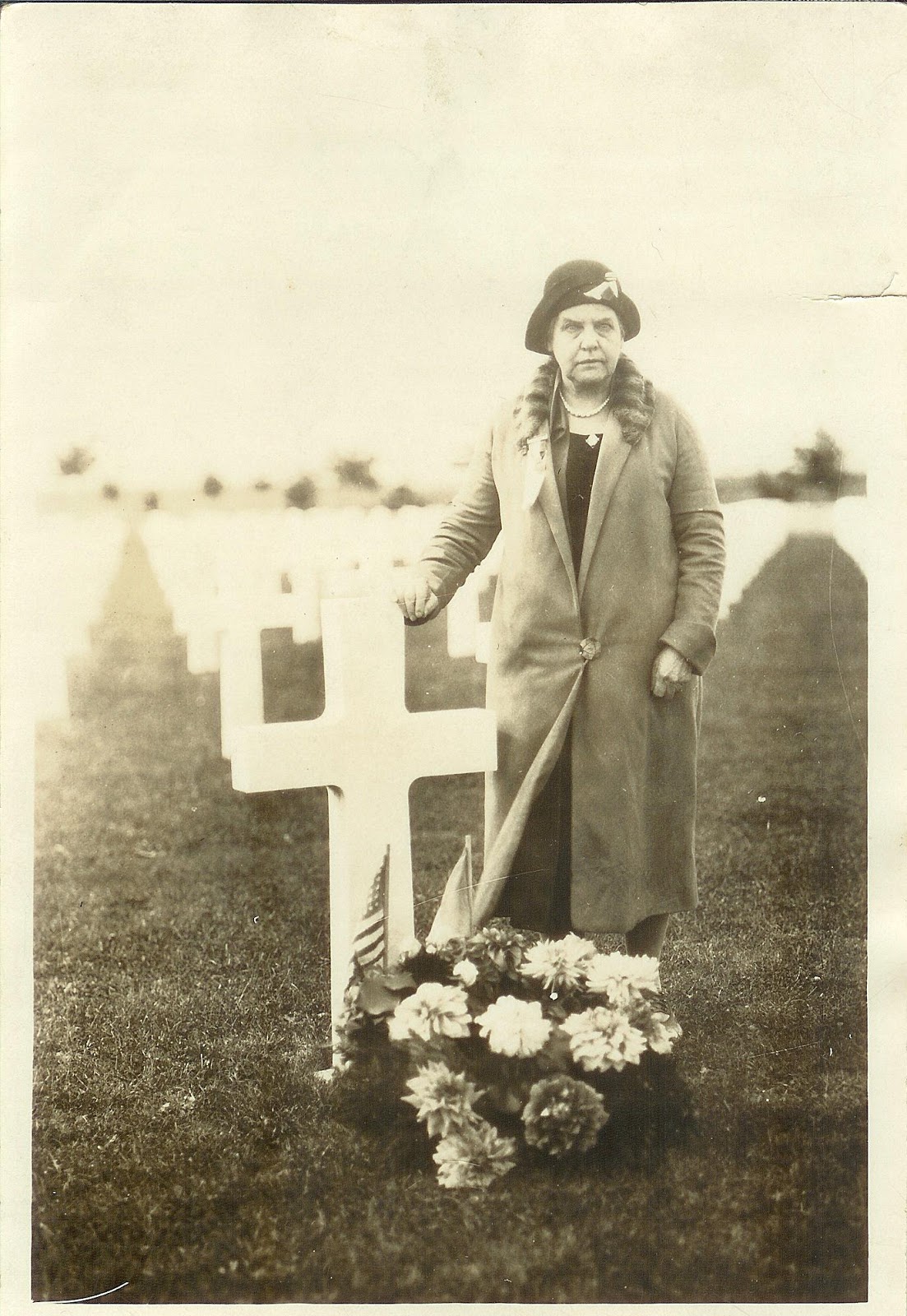
The accompanying photo of Mrs. Hendershott, taken 13 years after her son’s death, truly shows the pain she could not hide, reflected in her eyes as well as that clenched fist at her side while she connects to the cross at her son’s grave, Block D, Row 12, Grave 12, St. Mihiel American Cemetery, Thiaucourt, France.

"Photo : Frances at her son “Willie’s” grave at St. Mihiel Cemetery in France, 1931."

Text accompanying this photo:
Gold Star Mother Mrs. Frances Hendershott’s Pilgrimage to Her Son’s Grave in France 
      "The Gold Star became a symbol for mourning the fallen. Families who lost a loved one in the service hung a Gold Star in their windows. Their female relatives referred to themselves as Gold Star mothers and widows. 
     "When Frances Hendershott’s only son, William, died of pneumonia in France, she became a Gold Star Mother. 
     "Between 1930 and 1933 The United States government sponsored several pilgrimage trips for Gold Star Mothers and Wives who had lost their sons or husbands in the war and were buried in one of the 8 cemeteries in Europe. Frances Hendershott began her journey August 10, 1931, and returned on her 72nd birthday, September 13, 1931. 
     "All mothers and un-remarried widows of someone buried or memorialized at an American cemetery received an invitation. Over the course of the program 6,654 women participated. However, in keeping with the Jim Crow Era segregation of the military at the time, the U.S. Army Quartermaster Corps racially segregated the pilgrimages. African-American women travelled in separate groups. While many objected, 168 African-American women still participated as pilgrims. 
    " Even after the crash of the stock market in October 1929 and the onset of the Great Depression, the federal government funded the entire pilgrimage. The Quartermaster Corps meticulously organized the program and cared for the mothers and widows. They arranged every detail of the journey and monitored the pilgrims’ physical and emotional health. Escorted by Army officers and nurses, the pilgrims traveled to many of the major tourist sites in the countries they visited, including the Arc de Triomphe in Paris, where they laid a wreath on the Tomb of the Unknown Soldier. They subsequently traveled to the cemeteries and visited the battlefields and memorials in addition to the graves of their loved ones. 
     "Cemetery staff decorated the graves with the flags of the U.S. and the host country. They provided a chair for the pilgrim to sit next to the headstone and reflect. Each pilgrim received a photograph of herself at the tombstone, where she also laid a memorial wreath. These personal touches added to the dignity of the pilgrimages and demonstrated the government’s commitment to the cemeteries."

I am so grateful to the Arcade Historical Society (www.arcadehistoricalsociety.org)Hendershott Manness VFW  #374, and Carole for all of this information. I hope that I will be able to photograph his grave on our trip to France. Our visit to St. Mihiel American Cemetery will be August 13, 2018. It would be my honor to do this. Bless Carole J. for contacting me!

My next blog will be about the other man VFW #374 is named for, Arthur Manness.

 [Note 1: The 78th Division’s shoulder patch was a bolt of lightning across a red field. The battles of that division were likened by the French to a bolt of lightning leaving the field blood red. Hence the 78th Division was known as the Lightning Division]  


[Note 2: The World War I St. Mihiel American Cemetery and Memorial in France, 40.5 acres in extent, contains the graves of 4,153 of our military dead. The names of 282 soldiers missing in action appear on two walls in the museum.]


Tuesday, July 17, 2018

OUR HEROES DON’T ALWAYS COME HOME, PART II: Remembering Robert F. Arnold


17 July 2018
Erie, Pennsylvania

My World War I journey has taken so many twists and turns. I think of my Uncle Archie and how he never could have imagined a great niece taking an interest in his story and going so far as to read over 40 books on World War I to say nothing of the hours of DVD WW I footage I have watched, the maps I have pored over, and being on the eve of my 2nd trip to WWI battlefields in France. I think my uncle was representative of so many young courageous men who wanted to represent their country, who wanted to “take their stand with the Armies of many nations now fighting in the Old World the great battle for human freedom.” * 

I have taken many paths on this journey, but all those paths ensure that I recognize the courage, the valor, and the faith that our American soldiers and those who supported them had as they engaged in war so very far away from home.

A New Friend
The National Society of the Daughters of the American Revolution (NSDAR) has joined with the World War One Centennial Commemorative Commission which formally recognizes Commemorative Partners who demonstrate a commitment to honoring, commemorating, and educating the public about The Great War, to include (but not limited to) the 4 million Americans who served and the 116, 516 who sacrificed their lives

So recently, by chance, I was navigating a DAR World War I Facebook page when I saw a post indicating someone was looking for her uncle’s grave in France.


I messaged Sandy from Texas that I was going to France and would be pleased to look for her uncle’s grave site. As it turned out, her uncle, originally from St. Louis, Missouri, is buried in the United States.

However, our research did lead us to the discovery that her uncle, Robert F. Arnold, was in the 28th Division, 112th Infantry, the same unit that my uncle and Friend Ann’s great uncles were in. Then I found Robert Arnold’s name in the book I have mentioned before, With the 112th in France, A Doughboy’s Story of the War, by James A. Murrin.

The listing was as follows, “Robert F. Arnold, 2d Lt., Co. H; died October 13th from shrapnel wound received in action in early part of the Argonne Battle.”


This is only a listing in a book. We know there is so much more to the story—a young man who had a life in Missouri yet joined the National Guard and became an officer. He lost his life serving his country. A young man whose family mourned him then, and still mourns today.

The entire book by Murrin can be found at this website:

I value Sandy’s interest in World War I, and her uncle. I will honor him, my Uncle Roy, and Ann’s uncles at Fismes, France, and other sites where the 112th was engaged.

* King George V: Letter to Soldiers of The United States - April 1918. Each soldier was given a letter from King George III of England. This is part of the that text.


Monday, July 16, 2018

OUR HEROES DON'T ALWAYS COME HOME, PART I: Remembering Russell W. Silverthorn


16 July 2018
Erie, Pennsylvania

A few years ago, I made a new friend through membership in DAR. We discovered a common bond when she told me she had two great uncles in the 28th Division, 112th Infantry, too. My Uncle Roy Hall was in the 28th Division/112th Infantry.

Ann’s great uncles were brothers who were in the Pennsylvania National Guard Unit, the 112th, which originated during the American Civil War.


The unit was mustered into active service on 16 July 1917, exactly 101 years ago today, for service in World War I. On 11 October 1917 the 112th Infantry Regiment became part of the 28th Infantry Division. The 112th was the first war-strength National Guard regiment in the United States. It reached France in May 1918 and  went onto the line on 4 July 1918, in the Second Battle of the Marne.

From that day on, the names Fismes, Fismette, Fond de Mezieres, and Argonne would never be forgotten. The second battalions Companies G and H lost a combined total of 200 men out of 230 when they were cut off at Fismette and fended off a frontal attack on their position by a thousand German soldiers. As James A. Murrin said in his introduction to his book, With the 112th in France, A Doughboy’s Story of the War, “It’s men were no different from thousands of others who claimed allegiance to the 112th, who trained with it at Camp Hancock and who fought with it from Marne to the Vesle, through the Argonne and on the Thiaucourt sector, [and who] believe it to be worthy of a place in history.” James Murrin was in the 112th Infantry and wrote this book in 1919.

According to Murrin, “…the 28th Division stands fourth on the final Army casualty list and first on the roster of the National Guard Regiments participating in front-line engagements is eloquent proof that the Keystone organization was in the forefront of the battle.”  Indeed they were. Further Murrin states, “Nearly four thousand of those boys lie ‘somewhere in France,’ sleeping the last long sleep, and eleven thousand others are on the list of wounded, the majority of them back in the States."

Ann’s uncle, Russell Worth Silverthorn, was one of those casualties, losing his life at the “Tragedy of Fismette.”  Russell’s brother, Lee James Silverthorn, was injured by mustard gas a month before Russell died.

In a more recent discovery, Ann learned that she also had a great uncle, Josef Wäschle, a German soldier, who was killed, presumably by a French sharpshooter, and was buried near Reims, France.  Ann, a writer, penned a very poignant essay on her website, WWI, A Perspective on the Concept of “Enemy.” 

Here is a link to her site:

As I mentioned before this journey has taken me in many directions and next I will write of another connection I made with a new Texas friend whose great uncle was also in the 28th Division, 112th Infantry.

Sunday, July 15, 2018

OUR HEROES COME HOME

Erie, Pennsylvania

The Day after Bastille Day
When I started this journey over twenty years ago, I was focusing on the story of my great uncle, Russell Archie Harvey. I found letters he wrote to his mother from France during the Great War when my mother died in 1992. Sadly, I did not look at the box for almost six years.

I have learned so much since that day, including the fact that my great grandmother, Phidelia Skiff Harvey, was a five blue star mother. Her only son, Archie; her son in law, Earl Beardsley; two grandsons, Roy Ward Hall (my uncle), and Lynn Parker were all in France with American Expeditionary Forces. Another grandson, Dayle Wanamaker, was also in the U.S. Army as a photographer, but I have yet to find documentation on his service in France. A son, a son in law, three grandsons. I cannot  imagine how a mother/grandmother would feel with five of  her loved ones in service during wartime.

Archie sent this handkerchief with Junkerath embroidered on it to his mother from Germany. The 90th Division was part of the Army of Occupation in Germany after the Armistice. The pins, enameled blue star pins, were pinned to the handerchief. I found it with the box of Archie's letters.


I know so much more now and here are some specifics:
·       Russell Archie Harvey (my great uncle): U.S. Army 90th Division/357th Infantry/Co. K—Company Scout. The 90th Division was out of Texas and Oklahoma, sometimes called “Tough Ombres” for the patch they wore with the letters T and O. Archie was drafted while working as a farmhand in Iowa, then sent for training in Camp Dodge, Texas. He survived but died five years after the war, no marriage, no children.


One version of the 90th Division should patch
·      
         Earl Beardsley (my great uncle, married to my Aunt May Harvey Beardsley, Archie’s sister): U.S. Army 37th Engineers/Co. E. Uncle Earl and Aunt May lived in Cleveland, Ohio and we made frequent visits to their lovely home. They had no children, but it was Aunt May who had the foresight to save Archie’s letters and other artifacts.

·       Roy Ward Hall (my uncle, 21 years older than my mother---she was born while he was in France): U.S. Army 28th Division/112th Infantry. The 28th Division was called the “Keystone” Division since most of the men were from Pennsylvania. Many of the men in the 112th Infantry were from Erie, Crawford, and Warren Counties. My Uncle Roy and Aunt Georgia Hall lived in Dunkirk, New York for most of my childhood. They had no children. I knew that Uncle Roy was wounded in the war and carried shrapnel in his hip all his life. The Army tried to induce him to rejoin the Army for World War II. Uncle Roy was 42 years old in 1941.


One version of the 28th Division shoulder patch
·        
      Lynn Parker (1st cousin, once removed): U.S. Army 80th Division/313th Machine Gun Battalion. Lynn was the son of Salinda Harvey Parker, another of Archie’s sisters.  He died in 1934 at the age of about 42. The 80th Infantry Division was nicknamed the "Blue Ridge Division"as it was initially composed of draftees from the mid-Atlantic states of Virginia, West Virginia, Pennsylvania, and Maryland.
One version of the 80th Division shoulder patch

·      
          Dayle Wanamaker (1st cousin, once removed): U.S. Army Photographer. Dayle was the son of Edith Harvey Wanamaker, another of Archie’s sisters. My family visited Dayle and Aunt Edith in North Carolina in the 1950s. He made a small wooden doll chair for me, which I still have.

My understanding of each of these men and their efforts during the war has evolved with my research. Now I have read books about the 90th Division, the 357th Infantry, the 80th Division, the 313th MG Battalion, the 28th Division, the 112th Infantry, the 37th Engineers, and so many more. I am grateful to those who have written such books, including several that were written just after World War I. 

With the evolution of my thinking, I believe that my family members here are representative of the American Doughboys who fought in the Great War, men with faith who were loyal to America.

L to R. Roy Hall, Lynn Parker, Phidelia Skiff Harvey, Archie Harvey, 
Earl Beardsley. c. 1919     My Great Grandmother Phidelia is 67 years old in this photo.

This is one of my favorite photographs. It was labeled "Our heroes come home"
 in the family scrapbook, in Aunt May Harvey Beardsley's handwriting. 


Tuesday, June 26, 2018

AMERICAN ARMIES AND BATTLEFIELDS IN EUROPE--a fine book!


Tuesday, 26 June 2018
This blog should be more like a blog than report, but I have just started reading American Armies and Battlefields in Europe, A History, Guide, and Reference Work, published by the American Battle Monuments Commission in 1938. It is a total treasure and I am grateful to Mike Hanlon for making it “required reading” for our tour in August. I ordered the hard cover book from Amazon/vintage-books for $54 and it arrived in pristine condition, complete with separate maps. The book is now unavailable, so I am glad that I ordered it in February!

The book is thorough, but succinct. I have several other books about the 90th, the 28th, and the 80th Divisions for information specific to their engagements in France. Family members were in each of these divisions plus the 37th Engineers—I have yet to find out which division this unit was with. My World War I library would rival many amateur historians and I have read and made notes in every book. I am certainly not an expert though.

Last night when I typed up the updated itinerary (subject to change), I was very happy to see that we are revisiting some places we saw before. For example, the Douaumont Ossuary near Verdun was such a moving site. One cannot take photos inside the chapel and perhaps this year there will be a portfolio of photos for sale. As mentioned in 2015, the tower of the structure is shaped like an artillery shell but is cathedral-like with Christian images on the exterior. When we stepped inside the building, the silence was remarkable. It was cool on a sweltering day. Thousands of names are engraved on the walls. Inside the chapel the stained-glass windows depicted stunning images of battlefields with crosses. One window depicted two angels holding a nurse (red cross on her veil) who was wounded in the war when a hospital was bombarded. Another image is of Christ cradling a soldier. The Crucifix at the Altar is Mary holding Christ upright, both have arms outstretched to form a cross, an image I have never seen. I see these images in my mind, but they are difficult to share with others—the impact is not the same.

Other places that I want to see again include the American cemeteries, Seicheprey, and the Pennsylvania bridge at Fismes. Only after the 2015 trip did I realize that my Uncle Roy W. Hall was in the 28th Division—I knew that he was in the 112th Infantry. In 2017 my brother gave me Uncle Roy’s doughboy helmet, with a red keystone stenciled on it.  The 28th Division was known as the Keystone Division, mostly Pennsylvania men.

I will continue my research on my great uncle, Russell Archie Harvey—I hope to honor him in a special way on this trip, especially if we get back to Baalon, Mouzay, and Stenay, France. Another purpose of this trip is to honor not only my dear family members but all service members who served during the Great War.


Monday, June 25, 2018

PLANNING FOR OUR 2018 AEF WORLD WAR I CENTENNIAL TOUR!


This is the schedule for our upcoming tour--I want to be truly prepared!! [Note: 29 July 2018-There were a few changes in the schedule and I have adjusted it  here]

AEF WWI CENTENNIAL TOUR 2018
With Michael Hanlon

Tuesday, 7 August 2018
Golden Tulip Hotel/CDG
Paris, France (Roissy)
Welcome Dinner

Wednesday, 8 August 2015
New Regina Hotel
Flanders Fields, Belgium
The AEF in the Somme/Cantigny/In Flanders Fields, Part I
Cantigny
Hamel
Chipilly Ridge
Mont Kemmel
Flanders Field Museum
Menin Gate
Last Post Ceremony


Thursday, 9 August 2018
Best Western Plus, Hotel des Francs
Soissons, France
In Flanders Fields, Part II/Taking the Hindenburg Line
II Corps Final Advance
U.S. Flanders Fields and Somme Cemeteries
Blerancourt French-American Museum

Friday, 10 August 2018
Best Western Plus, Hotel des Francs
Soissons, France
Four Battles at Chateau-Thierry/Chateau de Blerancourt/Compiegne Armistice Glade
Marne River
Belleau Wood
Vaux
Soissons
U.S. Aisne-Marne Cemetery
Hill 204 Memorial / Visitors Center
Churches
            Belleau
            Chateau-Thierry

Saturday, 11 August 2018
Best Western Plus, Hotel des Francs
Soissons, France
The Second Battle of the Marne

Rainbow Division at Croix Rouge Farm and the Ourcq River
Pennsylvania Bridge at Fismes
U.S. Oise-Aisne Cemetery
Landowski’s Second Battle of the Marne Memorial

Sunday, 12 August 2018
Les Jardins du Mess
Verdun, France

Chemin des Dames: The Yankee Division/Operation Blucher/ Champagne Operations: 15 July 1918/ Blanc Mont/Sechault

Champagne
Argonne Forest Flank
Navarin Farm
Blanc Mont
Sechault
The Harlem Hellfighters
The Lost Battalion
Sergeant York

Monday, 13 August 2018
Les Jardins du Mess
Verdun, France

St. Mihiel Salient
Eparges Spur
Bois Brule
Seicheprey
Regnieville
Thiaucourt and Closing the Salient
Yankee Division’s Big Moment
George Patton Leads America’s First Tank Attack
Montsec Memorial
U.S. St. Mihiel Cemetery
PS: Just in case you have yet to travel to St. Mihiel Cemetery, the namesake of our VFW Post is William Hendershott.  He is buried there at Block D, Row 12, Grave 12.  A photo of the way it looks today would be fantastic


Tuesday, 14 August 2018
Les Jardins du Mess
Verdun, France

The Meuse Argonne Offensive, Phases I and II
Opening Attacks
Forges
Montfaucon
Vauquois
Varennes
Cheppy
Second Phase at Fleville
Cierges
Cunel
Romagne
Capt. Truman’s War
Montfaucon Memorial
U.S. Romagne Cemetery

Wednesday, 15 August 2018
Les Jardins du Mess
Verdun, France

The Meuse Argonne Offensive, Phase III
Attack of 1 November and Breakthrough to Sedan
Crossings of the Meuse Rive
Fighting on the Meuse Heights
Balloon Buster Frank Luke’s Last Fight
Henry Gunther—Last to Fall Memorial
Verdun-Memorial and Ossuary

Thursday, 16 August 2018
Golden Tulip Hotel
Paris, France (Roissy)

The AEF and the Voie Sacree/America’s Unknown Soldier/Musee de la Grande Guerre at Meaux
Voie Sacree Monument
First Army Headquarters, Souilly
Rembercourt Airfield for the 50th and 94th Aero Squadrons
Behonne Airfield of the Lafayette Escadrille During the Battle of Verdun
Chalons-en-Argonne Town Hall, Site of the Selection of the U.S. Unknown Soldier
Musee de la Grande Guerre
Farewell Dinner at the Golden Tulip Hotel in Paris, France (Roissy)